Showing posts with label walking. Show all posts

Saturday, 27 June 2015

Brick Lane By Night

Last Saturday night I joined up with the people from London Photo Walk to go on an all night solstice walk. We covered about 23km over 11hrs or so. It was a long but extremely rewarding night and I look forward to doing it again next year.

graffiti, street art, east london, brick lane, urban, black and white, colour pop, long exposure, light trail


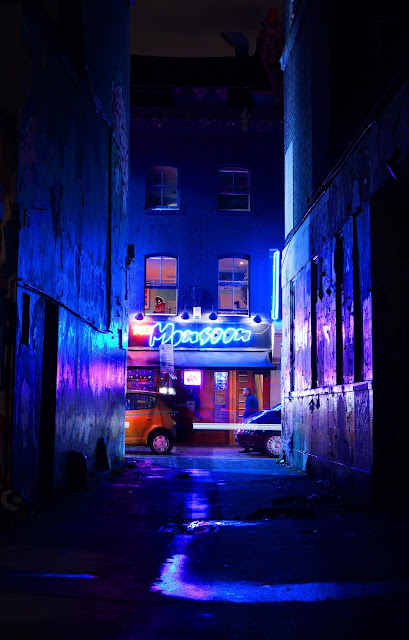
Given that this took place all through the night exposures were all very long, generally 15-30 seconds. It was also quite difficult to even know exactly what you were pointing your lens at as it was so dark in some of the back alleys and so composition wasn't always straightforward. This meant that over the 11hrs I only took about 100 photos; but there was a definite benefit to this. It was a bit like shooting with film, you were forced to put a lot more thought into what you were doing. If you pressed the shutter at the wrong time then you wasted half a minute of your life, which may not sound like much but it is quite the motivator when the wind is blowing at three in the morning.

graffiti, street art, east london, brick lane, urban, long exposure, fox, neon


As I said, we covered a lot of ground that night but the four photos in this post are all from the ever fascinating Brick Lane; one of my favourite streets in the world. Endlessly interesting and always full of life I have spent countless hours walking it's length, generally in the dead of night, but this was the first time I had ever taken my camera with me. I think it paid dividends. It isn't very difficult to make great art look good and obviously street art lends itself to street photography, something I normally struggle with.

 east london, brick lane, urban, blue, alley, ghost,

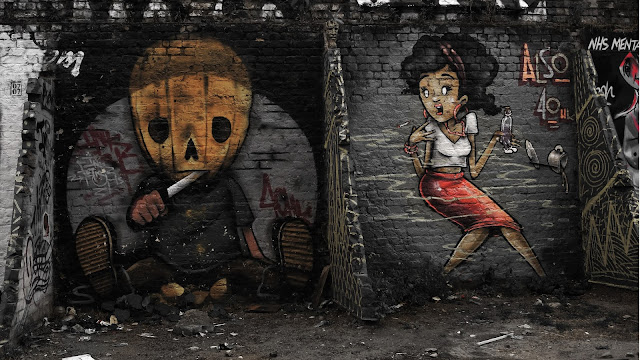
Except for the fox, each of the pictures here have undergone quite a lot of post processing to bring out the best in them, or, rather, conceal the worst in them. These pictures were quite busy and messy to start with and mostly what I have done is to crop them down and remove colours to hopefully simplify them and make them easier on the eye. The shot below is a great example of where the original exposure wasn't up to snuff. There was different coloured crap all over the floor, the edges of other artworks to either side and and some unattractive lintels over the top. I cropped out most of all that, made it black and white to remove the distracting colours and then just allowed the reds and yellows to come through to keep it simple. Hopefully the result is a more satisfying picture that allows you to focus on the graffiti. It's a cliche but less is often more.

graffiti, street art, east london, brick lane, urban, black and white, colour pop, long exposure

Monday, 27 August 2012

South Bank Sunset

London, Thames, bunting, sunset, river, lamp post, silhouette
Thames-side bunting, perhaps left over from the Jubilee celebrations


Those of you who follow me on Twitter will know that last Sunday I went on a London Photo Walk along the South Bank. This is basically a group of people that meet up and then stroll along a pre-agreed route taking pictures as we go. This is only the second walk that I've been free to go on, the first one being on Broadway Market back in January which I wrote about here and here. It's a really informal meet and the idea behind it is simply to meet up with a group of friendly, like minded people. I normally take my best photos when I'm on my own, when I have the time to focus on what I'm doing, take my time and not feel guilty about slowing down or ignoring whoever I'm out with, normally my wife. It's a little bit different with this group though as we all have the same ultimate goal: to share ideas and put them into practice.

London, Thames, bunting, sunset, river, lamp post, silhouette
This busker made a good silhouette but was singing Coldplay so I had to be quick
When the route for this particular walk was decided I had mixed feelings; I love the South Bank, I go down there at least every fortnight if not more often, the walk along the Thames from Westminster to Tower Bridge is one of my favourite past times; but, on the other hand, there is probably no where on Earth that I have more thoroughly photographed so would there be anything there to catch my interest?

The simple answer is: yes, of course. If I went there every week for the rest of my life there would still be new and interesting pictures to be taken, and if one day I went there and couldn't see anything exciting then it would be my lack of imagination that was at fault.

So what was there to see? Well, we stated at the London Eye and walked passed the South Bank Centre and on towards the Tate Modern; there, we crossed over the Millennium Bridge, scooted around the east side of St. Paul's and headed for the roof of One New Change, a new shopping centre. On the roof they have a bar and restaurant and also a terrace that offers views south and west back towards our start point at Jubilee Gardens and County Hall. The main feature of this fantastic view, though, was the up close, up high vista of the dome of St. Paul's cathedral. I highly recommend a quick trip to this terrace if you are in the area, it really is a great view and is separate from the bar so you don't need to pay to be up there.

London, Thames, night, St. Paul's, cathedral
Sir Christopher Wren's masterpiece, St Paul's Cathedral
As you can see, it had gotten dark by the time I took this one but that was always the plan; the theme of the walk was sunset, which is why many of my photos make use of silhouettes. The photo I am most proud of however is the one below. Many times as I have walked beside the Thames I have tried to take a photo that does justice to the lamp posts that line the route. They are incredibly ornate and deserve a suitably dramatic portrait. The problem is that if you do close ups you just notice that they're really quite dirty and if you do a wider angle shot then they just get lost in the busyness of the cityscape. Here, though, I think I finally nailed it.  The shot is close enough to reveal some of the detailing of the lamp posts and yet wide enough to give them context. The silhouette effect helps remove detail from the mid and foreground so that they remain the central focus and I also like the perspective as they slowly recede deeper into the picture.

London, Thames, sunset, river, lamp post, silhouette
My favourite picture of the day
Any Londoners reading this that want to find out more about the group can do so here and I'll end by saying thank you to the organisers for another successful walk.

Saturday, 25 February 2012

Broadway Market

A few weeks ago you may have seen this graffiti laden post on the Regent's Canal, well I also spent an hour or so walking down Broadway Market and these are a few shots of what I came across. As you may remember, I was part of a much larger group, London Photo Walk, and as we progressed through the market we were certainly getting lots of strange looks.

My favourite is this first one of the dog. He was stood like that for over five minutes waiting for his master to come out of what I think was a chip shop. It caught the eye of several people and I wasn't the only person to capture it. If you're so inclined you can anthropomorphise all sorts of emotions and stories onto the little guy. Unfortunately, when the owner did emerge it turned out to be a rather unpleasant drunken tramp type chap.


This picture of a tower of suitcases isn't quite the one I wanted; what I wanted was to be right at the base of the tower looking up with a seemingly huge mountain of suitcases filling the picture. It was just outside a little flea market shop and stood about 6 feet high; I got down on the frozen concrete floor to try and get it right. If it had been warmer I could have composed it better - getting the tower square on, controlling the depth of field more and so on - as it was I just wanted to quickly get up off of the ice cold ground. This is my next best effort. It's retro look could well lend itself to the texturing/antiquing effect that I blogged about previously.


This last one is a curious one. I'm not really sure why I like it, I just do. The overcast conditions helped bring out the rich colours in the brickwork and obviously the painting is an unusual one. Maybe next week I'll look at it and decide it's rubbish but, for now, it remains.

Saturday, 11 February 2012

Regent's Canal


Reflection of a gas holder in the frozen surface of the canal

Another week brings me to another one of London's canals. Last Saturday saw me up and out in the biting cold to join in on my first ever London Photo Walk. What they seem to do is meet up every six weeks or so and wander along a predetermined picturesque route somewhere in the capital. There's no fee or dues to be paid, it's just a group of like minded people out and about with their cameras - it was great.


The route started at London Fields, went down through Broadway market and then out along Regent's canal before returning back to London Fields. At first I felt pretty self-conscious, I get nervous about street photography at the best of times nevermind when there's scores of strangers around and it's your first time at a new event. This wasn't helped by the fact that I was feeling a bit tender from the night before. The jitters quickly disappeared though as being in such a large group was actually a big help, everywhere I looked there was someone with a camera in front of their face snapping away.


Not only did this large group help give me a bit of a safety-in-numbers style boost in confidence but they also gave me lots of good ideas. If I saw someone near me take a shot then I wanted to know what it was of, sneaking a peak over their shoulder to see what they had captured. This gave me a fresh perspective on scenes that I might otherwise have passed over unnoticed.


The Regent's Canal is linked to the Lea Navigation canal that I blogged about a few weeks ago near the Olympic Park via the Hertford Union Canal. The canal itself was probably a little less pleasant than the Lea, perhaps not benefiting from an Olympic inspired clean up. One similarity between the two though was an array of excellent graffiti; I know many consider this nothing more than vandalism but, in the right setting, it's rapidly becoming one of my favourite art forms. I suspect that, as I and numerous others on the walk were photographing the big bird motif, we may well have caught the artist in the act. It looked a lot brighter than everything else in the area and the man standing furtively next to it with a carrier bag of what could well have been spray cans was behaving very strangely. He clearly didn't look comfortable having people paying close attention to what he was doing, but at the same time he didn't leave, he must have had more work to do.


The only draw back to this excellent event was the biting cold. Those that know me will know that I love the cold, it's very much my sort of weather; this was a different matter however. To be able to use my camera properly I can't be wearing gloves, they're too clunky and I can't feel my way around the camera. No gloves and two hours at sub zero temperatures left my hands a little worse for wear. For the last half hour I couldn't feel the shutter button and often actually had to watch what my fingers were doing to know what I was up to. When I text my wife once it was over it took me nearly five minutes to write a simple message because I couldn't really move my fingers. Making a fist as quickly as I could took me nearly five seconds and my little finger wouldn't move at all. My hands were in not inconsiderable amounts of pain into the next day and holding anything with them was particularly painful.

I now own a lovely pair of fingerless gloves.

Saturday, 21 January 2012

The Lea Valley


The ArcelorMittal orbit

Over the past 6 months or so as I walk to work I've been able to watch a strange structure slowly rise up out of the ground on the Olympic site. Now, I'm no fan of the Olympics but I do like interesting architecture and, living just a few hundred yards from one edge of the site, I've been able to watch a lot of building work in the last 5 years. Aside from the stadium and other main venues there have been bridges built, canals dredged, roads widened, stations redeveloped and railway track laid; being a bit of a geek I really enjoy watching these sorts of things develop as I walk or ride by. I like to watch the process, stage by stage, note the sequences, watch the people and observe how order is slowly borne out of seeming chaos. It was a treat then to see something so unusual as the Orbit emerge so close by.

This image is a panorama of three photos stitched together. Click on it to panorama-fy it up a bit

The Olympic site, which will be known as the Queen Elizabeth Olympic Park once all is done and dusted, is situated in the east end of London on what was largely an industrial area in years gone by. From my point of view the main item in favour of the Olympics has always been the redevelopment of this land into what should eventually be a pleasant and green space, which is always good. Criss crossing the whole site is the river Lea and the associated canals that used to supply the industry of past. Linking this area to other patches of more natural looking life is a route known as the Greenway. This stretches from the Royal docks further south on the Isle of Dogs (not only is this no longer an island but no one seems to be quite sure anymore as to the dog reference either) up through West Ham and Plaistow into Stratford, where I live, and on into Hackney. It's a sort of ribbon of green that picks it's way through the city and, as you walk along it, if you don't look too closely and avoid the horizon you can almost fool yourself that you're taking a turn through the countryside. Almost. Maybe a small town.


This looks more like the nice end of my home town than the edge of Europe's biggest building site
The route is almost entirely raised up on a large bank that gives away it's heritage upon closer inspection: it's a sewer. But not just any sewer. The Great Stink of 1858 and the cholera outbreaks of the same decade were what instigated legendary Victorian engineer Joseph Bazalgette to construct London's famous sewerage works. The Greenway rides atop the Northern Outfall Sewer which is responsible for taking all of north London's waste down to the Thames at Beckton. At the time it still wasn't common knowledge that cholera was caused by a bacterium, the sewers were built solely to remove the stink which happened to result in the water quality improving which got rid of the cholera.


Okay, I can feel myself getting over excited now so I'm going to stop talking about sewers. The point is that there are thin veins of greenery threading their way through what is normally considered a pretty grim part of the city and they're really quite nice. They are also currently the closest you are allowed to get to the newer building work (barring special events) passing within just a couple of hundred yards of the new stadium - near enough to hear builders guffawing with laughter when something large and expensive sounding got dropped.

I exposed for about 1/3 second to get the blurring effect on the water
So, for more than five years I had been living in the Lea Valley and completely ignoring it. This has clearly been a mistake. As my wife and I left the Greenway and started following the canal around the north of the Olympic site we managed to forget that we were right on top of a vast construction site. With the stadium and Orbit out of view behind us we were just left with one and two storey residential buildings, the tranquillity of the slow moving water and the ducks and swans that made it their home.

Even the water ways here that look natural have been heavily modified by man's hand. The river has been 'canalised'; which basically means it's been levelled off, made a bit straighter and generally made more navigable. Whilst on the walk I spotted that some signs said Lee and others Lea with no apparent rhyme or reason. Investigations revealed, though, that the parts that are still fairly untouched are still called Lea, whereas man-made sections and modifications are distinguished by being called Lee. Neat.


One of the great things about canals, asides from their history and functionality, is that they tend to be rather still; combine that with a windless day, like we had, and that means you can get some very nice reflections in the water. The above shot was at a sort of T-junction that was more open than most areas and therefore the water was more disturbed but I still loved the reflection from this construction site.


Another reason why I enjoyed this little excursion so much was that it was an opportunity to get out with my new camera. I bought a Sony A65 in the January sales and am very impressed with it so far. I wasn't sure at first as it's an SLT camera, not an SLR, but it has more than held it's own and is definitely opening up some new avenues for me. I won't go into any more detail here, I'll probably give it it's own post in the near future and clearly label it as a techy sort of post so that those not interested in geeky detail can skip over it. I'll be doing the same with a post on digitally incorporating textures into images at some point too.


The old canal with traditional barges moored and the 'Gherkin' rising up on the horizon
A couple of hours of walking took us two thirds of the way around the Olympic site and from there we got the train home. I suspect I shall be spending a lot more time walking along these canals this year. I think a wander down to the Royal Docks on the Greenway wouldn't go amiss either. Home just got a little bit nicer.


Sunday, 15 May 2011

The Inca Trial

Ever since I had heard of Peru I wanted to go there. For me, it held an almost mythical significance. It seemed like a land steeped in history, intrigue and staggering natural beauty. The Incas, the dominant native people of the time, and their brutal suppression by the Spanish Conquistadors was a story I knew very well and I longed to see their ancient forts and temples of gold first hand. And so it was, in the first year after graduating, instead of looking for a proper job my wife and I saved every penny we had to get there.

Most people have heard of the Incas but not many people know anything about them, often getting them confused with the Aztecs and Mayans of Mexico. The Incas were a very advanced civilisation, a true Empire even, with well established mechanisms of Government and administration, the keystones of all empires. And what an Empire. It stretched from Ecuador in the tropical north to Santiago, Chile, in the desert south; a distance of more than 3,000 miles taking in rainforest, high Andean mountains, the driest desert on Earth and a huge stretch of Pacific coastline. And at the heart of it all - Cusco. Meaning Navel of the World in the native Quecha language, Cusco was the capital of this vast empire. A city of hundreds of thousands of people, it was as large and advanced as any in Europe at the time; what they did not possess, however, was gunpowder, horses or resistance to European diseases. So it was in 1532, once Francisco Pizarro had been given permission to conquer them by King Charles, that the Incas had little chance of successfully defending themselves. The Empire had already been seriously weakened by a civil war between two half brothers for the imperial crown and had little left in reserve to withstand the European invaders. Still, no one could have predicted that the 80,000 strong Inca army could be beaten by 168 conquistadors. But let's not get too teary eyed about a poor, peace loving, native people being overrun by the evil White Man. The Inca Empire, like all Empires, had itself used brutal suppression in it's own emergence and upkeep.

The other key to a strong empire is financial might and here, once again, the Incas were not caught short. They criss crossed their lands with over 40,000 km of paths and trails that facilitated the movement of both caravans of alpacas bearing goods for trade and the swift distribution of Imperial edicts and the all important tax demands. Each of the trails was populated with runners, each responsible for their own portion of a few miles, who would run messages back and forth in one long relay. There were houses placed along the roads and each was populated by a small group of men, two of which were permanently on lookout. If they saw another messenger approach they would run to meet them and carry the message on the next leg of the journey. A message could cover over 150 miles per day this way which, given the terrain, is very impressive.

peru inca trail walking hike mountains clouds
Part of the ascent up to the second pass. Pretty steep.

La Camina Inca, or the Inca Trail, is actually a collection of these trails that essentially start at Cusco and end some 43 km away at the town of Aguas Calientes - literally, hot waters, so named because of the towns hot, natural springs. Machu Picchu is located an hours walk from here, almost vertically up the mountainside. The bulk of this distance is covered in a sprightly three days leaving just a couple of kilometres on the final day, to be covered in the early morning darkness so that you can arrive just in time for the sun to rise; a magnificent sight.

peru inca trail walking hike mountains clouds
Hiking above the clouds

The terrain on the trail is extreme. There are two passes to be crossed and there's no avoiding them, the highest of which will take you to nearly 14,000 feet, or half the cruising altitude of a passenger jet. So although you may only have a target of 7km distance to cover over a morning you will also have to climb 1,500m and descend halfway back down again. For example, on the morning of day 2 you have to spend 5 hours climbing the 1,200m of the Dead Woman's Pass, up to a total of 4,200m. That's the equivalent of climbing Ben Nevis from sea level and going most of the way down again but at three times the altitude; and that's all before lunch and the afternoon session.

But the true difficulty in this endeavour lies in the altitude itself. At 4,000m tying your shoe laces is difficult, I promise you. At that height, even whilst peacefully sitting still, you will occasionally gasp for air uncontrollably because your resting breathing rate is too slow. Throw in a back pack, the steepest paths you've ever seen and a system full of adrenaline and you begin to see where the challenge lies. It is strongly recommended that you spend a few days acclimatising in Cusco before setting off if you've arrived straight from Europe.

peru inca trail walking hike mountains clouds


The trail itself is a mixture of different types. For a while it might be pleasantly sloping gravel paths following the gently meandering Urubamba River, at other points it'll be a staircase cut into the naked stone of a cliff face one person wide. Needless to say Health and Safety has yet to make it to Peru, and that pleases me. I fear that if the Inca Trail went from Milton Keynes to Luton we would have closed it by now for being too dangerous. Sections of the trail are only a yard wide with bare cliff to your left and a bare drop of a thousand feet to your right. There are no fences. There are no ropes. If you fall, you die. There are also no short cuts, if you get injured or just plain decide you've had enough then you're out of luck. At best you may find an alpaca or mule you could be strapped to but you still have to travel the distance. There is a helicopter in the area but it will only pick you up if you have $5,000 in cash on you, so it's only really for the film crews that frequent the area. I'm not even going to tell you about the bit they affectionately call The Gringo Killer because you wouldn't believe me anyway.

peru inca trail walking hike mountains clouds
Paths are narrow and not to be played on

That said, thousands of people successfully complete the trail every year with very few casualties, and the rewards are more than worth it. Upon passing through the Sun Gate and seeing the sunrise behind Machu Picchu I've never witnessed so many adults in one place crying with tears of joy. The idea on the final day is to get up long before dawn so that you can beat the crowds of fat, lazy Americans that will arrive at Aguas Calientes by train throughout the day.

One of the most amazing aspects of the whole trip was understanding just how superhuman the porters were. At the end of each morning and evening session the group would slowly plod into camp in dribs and drabs, throw whatever they were carrying onto the ground and collapse in a heap, exhausted. After a moment they would be brought a nice refreshing drink, and a little after that we'd all be shown into a large tent where there would be at least a two course meal already prepared. The porters would have all this ready for us. Having packed up all the tents, all the food and water everyone needed for the trip, all the equipment and anything else that the tourists had paid them to, they would carry all this along the track not slowly and methodically, not even particularly briskly but, literally, at a run. That way, having left after us, they would beat even the fastest of the tourists to the next camp with enough time to set up every tent and have a hot meal ready and waiting for us.
This is not one of my photos but nicely shows the massive burdens these guys can run along the mountains with.

The Inca Trail is closed through February, and once a year when there are no slow tourists clogging up the narrow paths all the porters get together and have a race with a prize for the winner normally in the region of $300. The winner generally covers the whole 27 miles, mountains and all, in under three and a half hours. Incredible. Anyone thinking of doing the trail needs to make sure they're going with a reputable company that ensures the welfare of their porters. Find out how much they get paid, just a couple of pounds per day can mean the difference to them between struggling to feed themselves and getting a decent salary; and remember to tip well.
peru inca trail walking hike mountains clouds machu picchu
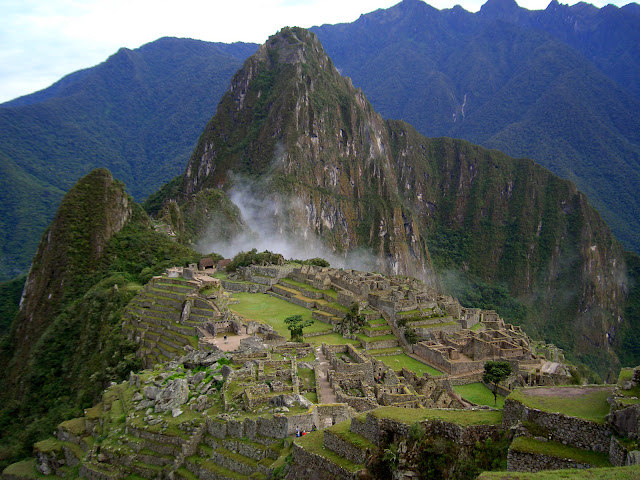
The classic Machu Picchu shot

No, the title of this post is not a spelling mistake, it truly was a trial, my wife will happily testify to that. It remains the most difficult physical challenge of my life and is likely to stay that way. But it was also one of the greatest achievements of my life. Sleep deprived because of the altitude and camping, constantly soaked by the tropical rains, physically exhausted from the exertion and deliriously happy despite of it all the Inca Trail was a lifelong ambition fulfilled and I'm only sorry I haven't had the chance to do it again since.


You can see more photos from my travels in south America at my website.

Thursday, 21 April 2011

Lake District - The Final Word

The Lake District is a truly beautiful part of the world. I can see why so many professional photographers choose to live there and by the time our week there was up I was very sorry to be leaving. It's the sort of place where, if photography is your thing, then you really can't afford to leave the house without your camera. There were several occasions where we would be driving along and spot an amazing view of a lake or a distant, jagged peak and just have to stop and stare in awe. I think having grown up amongst the flat isolation of the Fenlands has left me with an ever present wonder of mountains; and travelling up the length of the Andes in South America only served to reinforce this. It always leaves me minded of the sheer power of the forces that created these landscapes over the aeons. It has been a long standing ambition of mine to get to base camp at Mount Everest, but while Everest is ten times higher than our own top most peak, they each have their own character and allure. Years later I'm still able to pick out mountains in magazines and TV shows from the Andes; they left an indelible mark on me and I would dearly love to return one day.

lake district england lake pier jetty landscape


I think a lot of people don't realise what we have in this country and how lucky we are to have it. We have snow-capped mountains, vast lakes that stretch further than you can see, golden beaches that meet the horizon in both directions and, generally, the weather to enjoy all of this. Yes, there's never a time when you can guarantee it won't rain, but I've seen enough of the worlds deserts to know how fortunate this makes us.


lake district england lake landscape


Perversely, it is often cheaper to fly somewhere far flung and be waited on hand and foot than it is to catch a train within our own country and cook your own dinners; and, whilst I have made a point of getting to as many of the worlds beauty spots as I can humanly afford, I believe it is vital for us to remember that we have many of those places right here at home and we can be proud of that.

For those interested in seeing more of our fair land photographed by someone who actually knows what they're doing then I can highly recommend Joe Cornish (not Adam and Joe) and Charlie Waite.


lake district england lake landscape


Sunday, 17 April 2011

Scafell Pike: Take Two

As the name of this post suggests, this wasn't my first attempt at the summit of Englands highest mountain. I had gone there a few years earlier with a big group of friends with the sole purpose of getting to the top. We were camping in nearby Wasdale Head and the weather was against us from the start. Torrential rain that never stopped ensured that not only did not all the group make it to the top but that there was nothing to see in exchange for the labours of those that did. Knowing I would be a regular visitor to the Lake District, on that occasion I was happy to return having gone halfway up.

wasdale scafell pike lake district england landscape
The view back down to Wasdale Head

This time I was more confident. It was a cloudy start to the day but there was a strong wind coming in from the coast that was due to blow all that away by lunchtime. My only worry was that at nearly a kilometre of height the clouds might be a bit more stubborn. I needn't have worried, however, there was still bits and pieces of cloud here and there but more often than not they served more to give the sky depth than to obscure the view.

wasdale scafell pike lake district england landscape
Our lunch spot

We planned to do a circular route from Wasdale Head essentially walking clockwise around Lingmell, a total distance of about 15km and an estimated time of 6 hours or so, which turned out to be about right. For most of the journey it was t-shirts only weather with waterproofs firmly stowed away at the bottom of the bag. Only in the last couple of hundred metres of ascent did it get uncomfortably cold as we became less and less protected from the Atlantic wind; there were still a few patches of snow dotted around on the leeward slopes. The summit itself was very changeable. For thirty seconds you would have a glimpse to the north of Derwent water and then find yourself shrouded in cloud only for it to quickly break and reveal a beautiful vista of the coast of the Irish Sea away to the east. I didn't get a full 360 degree panorama but was very pleased with what I did get and, of course, it still leaves me something to aim for on my next visit.

Snowdon and Scafell Pike down; Ben Nevis and Slieve Donard to do.

wasdale scafell pike lake district england landscape

wasdale scafell pike lake district england landscape

wasdale scafell pike lake district england landscape
Lingmell from thr final ascent to Scafell Pike

wasdale scafell pike lake district england landscape
Wast water

wasdale scafell pike lake district england landscape


Aira Force - a waterfall to you and me

Force appears to be another one of those words that Cumbrians have hi-jacked and given their own meaning to; in this case force means waterfall, and Aire Force is a 70 foot example of this. Set about half a mile upstream from the west coast of Ullswater it is the largest of several falls on the Aire Beck - another word they've made up, meaning stream.

aire force lake distrcit england river water


The day was rather overcast and there was a lot of tree cover over hanging the often ravine like course of the river, this meant there wasn't the light to get the pin sharp, freeze-frame shots of the falls that I had hoped for. Thinking on my feet, though, it did mean that the conditions were right to play around with very long exposures that flowing water so lends itself to. This smooths out the ripples and splashes giving calmer water a glassy look and rougher water the appearance of candy floss.

aire force lake distrcit england river water


This was the first time I'd had the opportunity to try this particular technique out and I rather enjoyed it. Lacking a tripod until recently meant that any exposure over about 1/4 of a second would be blurred, especially with my shaky hands, and for this style to work you really need exposures of at least a second or two. Of course, once I realised I could do it I started getting more cocky and adventurous which began with the thought, "If I can just get the tripod set up down there....." and inevitably led to cursing and splashing and wet ankles. Still; I had fun.

aire force lake distrcit england river water


My attempt at the classic shot of this particular waterfall wasn't great, the spray was getting on the lens to the extent that it was ruining most of the photos. Some heavy cropping resulted in this effort:

aire force lake distrcit england river water

Monday, 21 March 2011

South Downs

I had never been to the South Downs before but by the time I was on the train back home I had begun to wonder what had taken me so long. Less than an hour from London the South Downs extend 70 miles from Hampshire in the west to Beachy Head in the east. It's a massive outcrop of chalk that's popular with walkers and fossil hunters alike.

south downs landscape blue sky
The initial assent from the village of Hassocks

The plan was to walk the 12 miles or so to the town of Lewes, north of Brighton. This was the best day for being out in the country that we'd had this year with warm sun, a gentle breeze and beautiful, blue skies. We reckoned on there being about 5 hours of actual walking not including stops which turned out to be about right, despite our improvised descent into Lewes.


south downs landscape blue sky
Cattle drinking from a dew pond

Just when legs were beginning to get tired we found an excellent watering hole and, fully recharged by a tasty pub lunch, the last few miles were soon dealt with. If any Londoners are looking for a quick escape to the country I can highly recommend this particular walk - less than an hour from London, less than £20 train fares and a fairly easy, well signposted walk; it beats another day of traffic and smog.


south downs landscape blue sky
The view north towards London
Having been frustrated by the recent cloudy weather, it was great to finally get some good shots of the good old English countryside. I'll be putting some shots up on my website and Flickr page in the next few days.