Showing posts with label blue. Show all posts

Saturday, 27 June 2015

Brick Lane By Night

Last Saturday night I joined up with the people from London Photo Walk to go on an all night solstice walk. We covered about 23km over 11hrs or so. It was a long but extremely rewarding night and I look forward to doing it again next year.

graffiti, street art, east london, brick lane, urban, black and white, colour pop, long exposure, light trail


Given that this took place all through the night exposures were all very long, generally 15-30 seconds. It was also quite difficult to even know exactly what you were pointing your lens at as it was so dark in some of the back alleys and so composition wasn't always straightforward. This meant that over the 11hrs I only took about 100 photos; but there was a definite benefit to this. It was a bit like shooting with film, you were forced to put a lot more thought into what you were doing. If you pressed the shutter at the wrong time then you wasted half a minute of your life, which may not sound like much but it is quite the motivator when the wind is blowing at three in the morning.

graffiti, street art, east london, brick lane, urban, long exposure, fox, neon


As I said, we covered a lot of ground that night but the four photos in this post are all from the ever fascinating Brick Lane; one of my favourite streets in the world. Endlessly interesting and always full of life I have spent countless hours walking it's length, generally in the dead of night, but this was the first time I had ever taken my camera with me. I think it paid dividends. It isn't very difficult to make great art look good and obviously street art lends itself to street photography, something I normally struggle with.
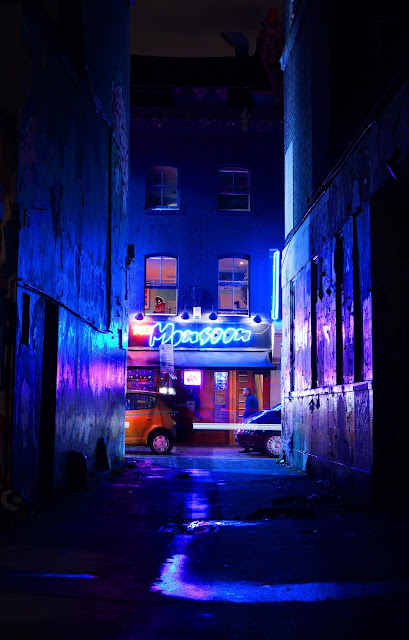
 east london, brick lane, urban, blue, alley, ghost,

Except for the fox, each of the pictures here have undergone quite a lot of post processing to bring out the best in them, or, rather, conceal the worst in them. These pictures were quite busy and messy to start with and mostly what I have done is to crop them down and remove colours to hopefully simplify them and make them easier on the eye. The shot below is a great example of where the original exposure wasn't up to snuff. There was different coloured crap all over the floor, the edges of other artworks to either side and and some unattractive lintels over the top. I cropped out most of all that, made it black and white to remove the distracting colours and then just allowed the reds and yellows to come through to keep it simple. Hopefully the result is a more satisfying picture that allows you to focus on the graffiti. It's a cliche but less is often more.
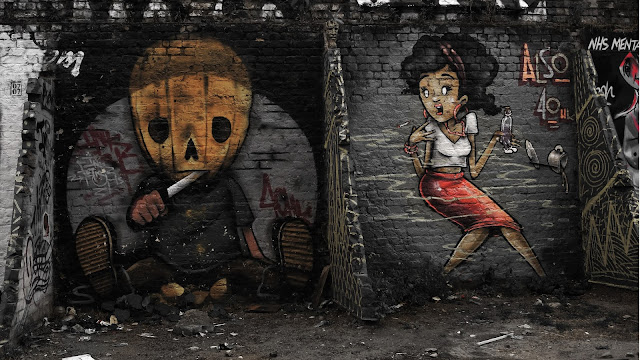
graffiti, street art, east london, brick lane, urban, black and white, colour pop, long exposure

Sunday, 28 December 2014

The View From St. Paul's


London, St. Paul's, cityscape, photo, landscape, capital, sky, clouds, city of london

A few months ago my mother came to visit. She wanted to visit St. Paul's cathedral and climb to the summit, and so we went. On that occasion I just took a few snaps on my phone but I returned a few weeks later, awesome annual pass in hand, to try and get some decent clicks with my proper camera. Unfortunately the weather was against me. The photo above has been quite heavily processed to try and make the best of the sky; I've gotten quite lazy and you can see halos (no pun intended) around the buildings on the horizon. I also need to clean my lens and sensor. Below, I've deliberately gone for a silhouette type effect to mask the fact that otherwise it would be quite an underwhelming picture.

Still, I've learnt a lot about the location; I know what sort of shots I want to get, what time of day I need to be there to have the sun at the best angle and, like I said, I have an awesome annual pass and so I'm going to keep going back until the weather is in my favour. God willing.

London, st pauls, silhouette, clouds, sky, the shard, cityscape, landscape, photo

Sunday, 19 October 2014

Vertical Abstraction

abstract, photo, photography, romania, mamaia, constanza, constanta

Whilst I was in Romania this summer I went to the beach resort of Mamaia a few times, largely considered to be the most popular beach resort in Romania, the whole resort is squeezed on to a spit of land 8km long but only 300m wide. On one of my trips there I rode the cable car back to Constanza, it takes about 7 minutes to cover the 2km distance. Although it's a bit pricey it does afford some good views of the area and saves you having to wait for the bus/walk/swim.


Like most cable cars, indeed like most other forms of transport, if you want to take any pictures you either have to get what you can through a tiny, inconveniently placed open window, or, shoot through a half inch of scratched, dirty plexiglass covered in the spit of a thousand window lickers. Neither option is ideal.


Inevitably, this was the situation that faced me. My highly creative and completely lucky resolution was to blindly fire off shots aimed straight down to the ground. Obviously I could see roughly what was coming up; a waterpark, residential blocks and so on; so it wasn't 100% chance, but it was mostly.

The one exception to this was the picture of the residential block. The setting sun gave it a wonderful orange glow that added to the already decades old feel of the building.


Sunday, 12 January 2014

The Thames Barrier

Thames, barrier, London, river, flood, landscape

Ahhhh, this feels good. Today I did something I haven't done in a long time: I went out with my camera, in the sun, to take photos just for fun. I wasn't doing it because the stupid 365 Project was making its daily demand; nor because I was at some event where tradition demands that a few badly shot pictures of blurry revellers be taken for posterity; nor because I happened to be visiting somewhere that, theoretically, I should be taking photos of. No, today it was just me, the camera, good weather, London and science podcasts. Bliss.

So it was I decided to head down to the Thames Barrier. It's only a few miles from where I live but I had never gone down there before; I soon realised I had been remiss, there were ample opportunities for some interesting photography. 

The Thames Barrier, then. Why is it there? How long has it been there? How does it work? And why does it look so weird? Some of these questions are easier to answer than others. The reason it is in that specific location is quite straightforward; the Thames, if you look at it on a map, is wrigglier than a three year old with ants in their pants but in this little section, between Silvertown in Newham and New Charlton in the borough of Greenwich, the banks are quite straight and parallel to one another; this makes it much easier to build a massive, water tight, movable barrier - the second largest in the world. Also, the underlying chalk bedrock in the area happens to be a little harder than the chalk and clay on which most of London sits and so could support the structure. As an aside, London is steadily sinking into the ground much as Venice is now, but that's a problem for another century. The other interpretation of the question Why is it there? - as in Why do we need it at all? - is also simple enough, if not a little tragic.

Thames, barrier, London, river, flood, landscape, sky, cloud

In 1953 a spring tide coincided with a severe storm over the North Sea, this led to a surge in sea level of over 5 metres. The first area to be affected was Scotland where 19 fatalities were reported, but conditions only got worse as the surge travelled south into the progressively more shallow waters of the southern North Sea. Approximately 1000km2 of eastern England were flooded with the sea encroaching as much as 2 miles inland in Lincolnshire and Norfolk. Over 1600km of coastline was flooded along with severe floods in Silvertown and Canning Town in East London; just a mile down the road from me. The result was tens of thousands being made homeless and 307 deaths. At sea, many trawlers and other boats were lost producing another 224 deaths.

Sadly, by comparison, we had it easy. The Netherlands, where a fifth of the country is below mean sea level and half of it is at less than 1m above sea level, over 1800 people were drowned as a quarter of the country was lost to the sea. There were also long term effects as being flooded by sea water is not like being flooded by fresh water. Having that much salt dumped onto the land devastates farm land or, indeed, any land where you might want vegetation to thrive.

As a result of this natural disaster, the second worst in British recorded history, the Government began planning how to protect us from such 1 in 1000 year catastrophes. Sea defences around the country were built/bolstered and a plan for some kind of barrier to protect central London was commissioned.

The design was first drawn up in the 1950s by Charles Draper but construction didn't begin until 1974; it was opened by Her Majesty The Queen on my 1st birthday in 1984 and, in today's money, it cost nearly £2b. There are five large piers and two smaller ones creating four 60m navigable spans and two 30m navigable spans. The 60m spans were specifically that size so as to be the same as Tower Bridge, i.e. anything that could get through Tower Bridge had to be able to get through the barrier too. I think my photos struggle to convey the scale of this area adequately; the river is over half a kilometre wide here, and you could fit Tower Bridge onto it four times just in the central section. It's huge.

Thames, barrier, London, river, flood, landscape


Used with permission

So how does the damn thing work? Hopefully the diagram to the right will help explain. Between each pier there is a hollow gate with a circular cross section; when the gates are closed this rests in a depression cut into the riverbed  allowing the free flow of water. To stop the fluvial flow these can be rotated such that nothing pass. To close the barrier isn't a simple task, though, it requires coordination with many other flood defences in the region and costs about £16000 per go.

The Barrier can protect London in two different ways depending on which direction the flooding is expected: from the North Sea or from the river itself. It's easy enough to imagine how it might protect London from the type of disaster experienced in 1953, you simply close the gate and, with any luck, nothing will get passed it and the areas down stream won't be too badly damaged either. But it can also help if there has been a lot of rain and the flooding is coming from upriver in the Thames basin. It does this by closing the gates during a low tide, this means that once the tide starts rising again it can't get back up river and this creates a basin of low level water that the flood water can run into allowing it to drain out of the city more quickly.

As it approaches it's 30th birthday the Thames Barrier continues to provide protection for Londoners; disconcertingly, though, this protection is having to be deployed more and more frequently. In it's first 6 years of use it was only closed 4 times, in the last decade it has averaged 7 times per year. Is this a possible measure of global warming? Are flood events occurring more often? In the fantastically complex science of climate change it isn't possible to draw a conclusion from one measure of anything, but it would seem to support that. The barrier was only designed to protect against a surge in sea level of 4.67 metres. If sea levels raise by a metre this century, as seems likely, then the capacity of the barrier to protect the capital would be greatly reduced. Add to that the slightly odd fact that Britain is tilting (the south and east are sinking and the north and west are rising at about 5cm/century) and the future looks ever more precarious. The original design was supposed to provide solid protection up until the year 2030 followed by a period of ever diminishing returns after that. The Environment Agency, however, who now runs the barrier, has said that it has no intention of replacing it before the year 2070. I do wonder if this is based on good scientific advice or on Governments that are not willing to spend money on insurance policies. Hopefully it won't take another disaster of the kind seen in 1953 to force their hand.

Thames, barrier, London, river, flood, landscape
The view to the west, Docklands and the O2 can be seen in the distance
After three hours I had only covered about 200 yards of the riverbank but I had had a great time. The weather and light were fantastic and it was good to be there knowing that I could write it up at my leisure in the style that I used to before the 365 Project consumed my hobby. I knew I would have the time to look into the history of this impressive structure and do it some justice in words as well as in pictures. Basically, I have my blog back and I love it. I hope you enjoy it too.

Sunday, 5 January 2014

Review of 2013....

Soooooooo, it has been rather a long time since my last post. This has been due to a number of reasons, partly laziness, partly lack of inspiration and frustration with the 365 Project, and partly because I have been in Romania for the last 3 weeks and internet connections there were few and far between. I will finish off the 365 Project, I have a bunch of photos on the back burner that I need to process and get written up and I will try to have that done by the end of the month. For now, I'm going to do one of those lazy Review of the Year posts with some of my favourite pictures from 2013. I won't include any from the period I haven't posted yet, you'll just have to be patient for those.

In 2014 I will be going back to my usual format of a post every fortnight or so. I think this gives me time to get some decent photos together and the words to go with them. I think the daily requirement of the 365 Project ultimately lowered the quality of what I do here, which was one of the reasons I became increasingly disenchanted with it. However, this does not foreshadow the year ahead, I am optimistic and enthusiastic about the blog for 2014. I have had 70,000 hits so far which is orders of magnitude more than I ever expected and so thank you to everyone who takes time out of their day to see what I've been up to. I'll try to raise the bar.

The last 12 months have been the most traumatic and difficult of my life, much of it self-inflicted, but there were certainly some good times too. Thank you to everyone who has stuck with me this far.


Gargoyle from inside the Natural History Museum, January.


View from Westminster Bridge, January.


Chain in Vienna, March.


St. Marco's piazza, Venice, March.


Venice, March. 

 
Parliament Square, London, May.


Pocketwatch, May.


Parliament Square, London, May.


 Dead flower, July.


 Olympic Park, September.


Thursday, 19 December 2013

365 Project: Photo 354

The journey continues....

Germany whizzed by at a great rate of knots but unfortunately we had a little more trouble once we got into Austria. It turns out the driver didn't know how to use the sat nav properly and he had merely plugged in the final destination and let the device do the rest. This is one of my major bug bears with sat navs, they stop people thinking. The mistake he made was to say that he wanted to avoid toll roads, this meant that instead of cruising along the E60 motorway avoiding the mountains we ended up snaking our way through mountainous back roads in the middle of the night. Along with the fog and the constant blind turns you might be forgiven for thinking that what you shouldn't do is drive in the middle of the road. This, apparently, is the safest way to negotiate such a route but having had to swerve back onto our own side of the road a few times I found myself strongly disagreeing with this philosophy.

After a couple of hours of this meandering at 20-30mph we eventually stopped for fuel at which point I leapt out of the car and bought an atlas. I eventually managed to pin down where we were and led us back to the E60 but the whole time the sat nav was forever telling us to get off the road. I insisted on being given the wretched thing and reprogrammed it, properly this time, and we soon made good progress through the rest of the country. Dawn brought Hungary which whizzed passed without mishap.


Since getting off the ferry in France the borders between each country have been non-existent. If you didn't keep an eye out for the sign announcing the frontier then you would never know you had passed into another country. There were no barriers or gates, no tolls or customs and no need for anything as archaic as a passport.

All that changed when we got to Romania, however. All of a sudden everything ground to a halt. Perhaps because they only get one car all day to look over the border guards decided that they would make the event last as long as possible. I wouldn't have expected three Romanians and an Englishman to have too much difficulty getting into Romania, but there were questions aplenty and the need to go to the little hut off to one side to pay the 'tax'. Once we were finally on our way again the going was a lot slower than it had been previously. Beautiful, slick, black tarmac gave way to pitted, gravelly tracks. As we crossed a wide, flat plateaux dotted with villages and farmsteads the difference in  affluence between the people of Hungary and Romania was stark.

As I look back the main images I have of that area are of a dead dog in the middle of the road, frozen stiff and entrails being picked at by crows; and an old man (I almost want to say 'peasant') sat on a crate at the roadside selling some home grown vegetables on a blanket. It's fair to say none of the produce at hand would have passed the QC of a British supermarket. The people here were dirt poor and I feared that all of the worst stereotypes that many of us will have of Romania were true after all. As we progressed, slowly, we got to the city of Timsoara which, happily, looked like any other city; although the undercurrent of poverty never completely faded.

This picture was taken by Georgiana as I slept. We had eventually come across a good road that should have shuttled us down to the capital, Bucurest, but it appeared to be closed. The third and final fuck up of the journey was when it was decided that instead of following alongside the main road on smaller roads for a while and then joining it later, we started ascending the Transalpine road. This felt a lot like climbing into Narnia. The road was frozen, the trees were frozen, waterfalls were frozen; everything was white, cold and hard. After nearly thirty hours of non-stop driving I didn't feel that this was the best way forward; the road was single track, the tyres we had were completely unsuitable, the driver was exhausted, and the place was completely deserted. It could have gone very badly wrong. I was, however, overruled. I was so pissed off about this that I decided to try to sleep my way through it.

Wednesday, 18 December 2013

365 Project: Photo 353

Finally! We're back on the road! This was sunset as seen from a German autobahn. Our unplanned and lengthy stay in Brussels ended at lunchtime today when we picked the car up from the garage. Unfortunately/stupidly we had a bit of a run in on Saturday night on the outskirts of the Belgian capital. Our driver hadn't noticed that the turn at the top of the slip road we were leaving the motorway by was a right angle. He valiantly tried to make the turn anyway, at 60mph, but failed. We mounted the curb destroying the tyre and the wheel and damaging the suspension. This was at about 2am and, would you believe it, there wasn't a local garage just waiting to fix it for us. I won't go into details here but two and a half days later we're back on the road. Only 30 hours of driving to go!!


Saturday, 7 December 2013

354 Project: Photo 342

Another trip up to High Barnet to visit friends, another carriage all to myself on the Northern Line.


Sunday, 1 December 2013

365 Project: Photo 336

The view from the train back down to London. I love the flat landscapes of east Anglia.


Tuesday, 12 November 2013

365 Project: Photo 316

The theme today is Simple Pleasures. This is one of the gateways into Russell Square where I come to sit and read my book every lunchtime. A simple pleasure.


Monday, 28 October 2013

Sunday, 27 October 2013

365 Project: Photo 300

Tonight was the local fireworks display in Newham. The weather was pretty good so I took the camera and tried to get some decent pictures, this was one of my better attempts. This is a 4 second exposure and I rather liked the blue colours.


Saturday, 26 October 2013

365 Project: Photo 300

Tonight I took my girlfriend, Georgiana, to a John Mayer concert at Wembley arena. We had pretty good seats, only about ten rows from the front, which afforded us a good view of the proceedings. I thought it was mostly quite tedious and bland. There was one exciting bit when he banged on about the Blues for five minutes, saying how great it was, I thought that here was something I could finally get behind; but then did a song that was in now way bluesy. Anyway, Georgiana thought it was awesome and I guess that's what counts. This picture is of the stage crew setting up between acts.


Monday, 21 October 2013

365 Project: Photo 294

Here's one where I actually deliberately set out to match the prompt for the day, a rarity these days. Blades and Bokeh was what I was aiming for. Most people seem to have gone the way of grass but I gravitated towards my magnetic knife rack on the kitchen wall. Blades on the left, bokeh on the right.


Sunday, 20 October 2013

365 Project: Photo 293

This reflection caught my eye as I entered Stratford underground station today. The theme today, which I generally ignore, was Something Beginning With P; well, there are clearly some pigeons at the bottom of the picture there.


Saturday, 19 October 2013

365 Project: Photo 292

As I was walking to work today I looked back the way I had come and saw the sunlight behind this tree. I've done a poor job of capturing it but I remember rather liking the look of it in the flesh.


Tuesday, 15 October 2013

365 Project: Photo 288

A pleasant sunset stroll along Hampstead Heath, my first visit there in a very long time. Taken on my phone and cropped, hence the graininess.


Thursday, 10 October 2013

365 Project: Photo 283

I was waiting about on the steps in front of Stratford Station and remembered that I had been on the look out for somewhere with a bit of height to try out some tilt shift shots. Sadly, I don't actually have a tilt shift lens to properly achieve the effect but most apps these days seem to be able to apply a blur filter in such a way as to give the miniaturising effect for which tilt shift is famous. I did this using SnapSeed, my phone editing app of choice.


Wednesday, 2 October 2013

365 Project: Photo 275

Hopefully this won't be one of the last clear days of the year. Westminster as seen from Lambeth Bridge.