Showing posts with label blur. Show all posts

Saturday, 20 December 2014

The Orton Effect

In the 1980s a man by the name of Michael Orton wrote an article on photography. In it he presented images of a kind that no one had ever seen the like of before. Today, these types of images are a mainstay of any photographer who wants to give a painterly or ethereal look to their photos; the technique has become known as the Orton Effect and below you can see an example of one of my pictures that has been given the Michael Orton treatment.

Back then he was doing this using film and, frankly, I have no idea how you would go about doing that because I have never worked with film. I can say that it is very easy to create digitally. I won't give a detailed step by step guide here but basically the steps are these: take your original image, slightly overexpose it, duplicate it, apply a Gaussian blur to the duplicate and then overlay the sharp image with the blurred one. It won't work for every picture, some work better than others and I haven't figured out yet what the formula for a good result is. I tried a few that didn't really do anything for me before I got to this one; which happens to be of possibly my favourite photo I have ever taken.

The Orton Effect, then, is a strange one; it seems to increase and decrease the level of detail all at the same time. It is difficult to describe what it does to an image but people tend to use words like romantic and emotional when trying to do so. My preference is painterly. 

cheetah, Africa, big cat, spot, orton, photo

Sunday, 5 January 2014

Review of 2013....

Soooooooo, it has been rather a long time since my last post. This has been due to a number of reasons, partly laziness, partly lack of inspiration and frustration with the 365 Project, and partly because I have been in Romania for the last 3 weeks and internet connections there were few and far between. I will finish off the 365 Project, I have a bunch of photos on the back burner that I need to process and get written up and I will try to have that done by the end of the month. For now, I'm going to do one of those lazy Review of the Year posts with some of my favourite pictures from 2013. I won't include any from the period I haven't posted yet, you'll just have to be patient for those.

In 2014 I will be going back to my usual format of a post every fortnight or so. I think this gives me time to get some decent photos together and the words to go with them. I think the daily requirement of the 365 Project ultimately lowered the quality of what I do here, which was one of the reasons I became increasingly disenchanted with it. However, this does not foreshadow the year ahead, I am optimistic and enthusiastic about the blog for 2014. I have had 70,000 hits so far which is orders of magnitude more than I ever expected and so thank you to everyone who takes time out of their day to see what I've been up to. I'll try to raise the bar.

The last 12 months have been the most traumatic and difficult of my life, much of it self-inflicted, but there were certainly some good times too. Thank you to everyone who has stuck with me this far.


Gargoyle from inside the Natural History Museum, January.


View from Westminster Bridge, January.


Chain in Vienna, March.


St. Marco's piazza, Venice, March.


Venice, March. 

 
Parliament Square, London, May.


Pocketwatch, May.


Parliament Square, London, May.


 Dead flower, July.


 Olympic Park, September.


Tuesday, 12 November 2013

365 Project: Photo 316

The theme today is Simple Pleasures. This is one of the gateways into Russell Square where I come to sit and read my book every lunchtime. A simple pleasure.


Monday, 21 October 2013

365 Project: Photo 294

Here's one where I actually deliberately set out to match the prompt for the day, a rarity these days. Blades and Bokeh was what I was aiming for. Most people seem to have gone the way of grass but I gravitated towards my magnetic knife rack on the kitchen wall. Blades on the left, bokeh on the right.


Saturday, 19 October 2013

365 Project: Photo 292

As I was walking to work today I looked back the way I had come and saw the sunlight behind this tree. I've done a poor job of capturing it but I remember rather liking the look of it in the flesh.


Thursday, 10 October 2013

365 Project: Photo 283

I was waiting about on the steps in front of Stratford Station and remembered that I had been on the look out for somewhere with a bit of height to try out some tilt shift shots. Sadly, I don't actually have a tilt shift lens to properly achieve the effect but most apps these days seem to be able to apply a blur filter in such a way as to give the miniaturising effect for which tilt shift is famous. I did this using SnapSeed, my phone editing app of choice.


Sunday, 1 September 2013

365 Project: Photo 244

This one actually took some doing. I was bored so I wondered into the Olympic Park to see if I could get a nice foreground for the sunset. For the first time in ages, though, the sunset was a rather muted affair and so I failed. As darkness fell the lights in the RUN sign outside the Copper Box became more prominent and so I tried to work with them for a while. Then it occurred to me that, although I'd been there for nearly an hour, I hadn't seen a single soul run by, just an endless procession of cars. All of a sudden a bus went by and I realised I could try to set this shot up - light trails and a juxtaposition of theme between the vehicle and the sign. Unfortunately, it was Sunday night and I had to wait for 35 minutes for the next bus. And so I waited. And waited. And waited. I passed the time by practising with cars and eventually the bus arrived and I got my shot. Annoyingly, I didn't have my tripod to hand so I think the focus is a bit soft but there was no sign of the proverbial second bus turning up and so I called it quits.


Friday, 28 September 2012

Starry, Starry Night


star, star trail, long exposure, astrophotography, Milky Way

First of all, a spoiler. The last photo in this post is a very special one. It's not one of mine and in of itself it is unremarkable but its importance can't be understated. More later.

*          *          *

At bloody last. For over one and a half years I had been waiting and I was finally going to get a chance. For 18 months I had been waiting to be in a rural location with a clear, cloud-free night. My goal was to take pictures of the stars and so I needed to be somewhere rural so as to avoid light pollution and I needed it to be cloudless for, well, obvious reasons. 

I am passionate about stars and the cosmos they sit in. I read more about physics, and astronomy in particular, than any other topic; more than the biology of my day job and the photography of my spare time. Asides from their preternatural beauty I love that they give up so many of their secrets simply by our study of the electro-magnetic radiation they give off; of which the visible light we can see is but one segment.

Within about 17 minutes of the Big Bang nearly all of the matter and anti-matter initially created in the universe had annihilated each other and left only hydrogen (75%) and helium (25%); all the other elements of the periodic table, which today make up about 2% of the matter in the universe, was created in the extreme conditions found inside stars where the intense temperature and pressure literally fuses protons together. What this means is that every single thing you can see is made of atoms that were created in the inferno of a star - we are all made of star dust.


In my first two photos here I have tried to capture the Milky Way, running top to bottom through the centre of the picture, with mixed success. The first one probably shows it most clearly but the exposure was a bit on the long side (188 seconds) so the stars are starting to move; they're in an awkward stage where they're not in sharp focus but they're not drawn out enough to be a proper star trail so it just looks a bit blurry, which isn't great. But I do like the garden being in the bottom of the frame as it gives the shot some context and sense of scale. What did surprise me was the orange glow in the lower portion of the sky, there was no hint of that with the naked eye. It looks as if I'm still in London and there is a city's worth of light pollution just around the corner but the nearest street light was about half a mile away in a small village, the nearest town was over 4 miles away; and yet there is still so much light pollution.

I tried to address the glow with the second picture by not including the horizon and pointing the camera straight up into the sky which seemed to do the trick although the exposure, again, is a little too long at 147 seconds.

The picture I was most pleased with was this next one, which was the first I took. I ended up taking five photos in all over the course of an hour starting at about 3am. Given this was my first attempt and, if I'm honest, I was quite drunk, I think it's not too bad. This was a long exposure of just over 9 minutes and so that nasty orange glow is back but this time the stars have moved enough for it to give a proper star trail effect. Next time I'm going to see if a soft ND grad filter will help with the orange cast at all. I deliberately aimed at Polaris to get a pin wheel effect; Polaris remains motionless in the centre and all the other stars have an increased degree of movement as they radiate out. What I really like about this photo is how the long streaks allow you to see the actual colour of the stars for what they are; very few are white, most of them are blue or a yellow/orange colour which you just can't make out with the naked eye. If you're reading this on your phone then you might struggle to make out the detail, I recommend having a proper look at home on your laptop (does anyone still have a desk top these days), click on the picture to engalactify it.

Overall I was quite pleased with how the session went, I learnt a lot. Hopefully I won't have to wait so long for my next chance to refine my technique. Next month we are going to Iceland and if there are clear skies then there will be a decent chance of seeing the aurora borealis so no prizes for guessing what I'll be blogging about in October.

star, star trail, long exposure, astrophotography, Milky Way

I'm going to end this post with that special photo I promised you. It is a photo taken by a machine and inspired by one of my personal heroes. The machine was the Voyager 1 spacecraft, the person was Carl Sagan. In 1990 the primary mission was over and he finally persuaded NASA that this was an important image to try and get. NASA were reluctant as they would effectively have to point the camera at the sun and they were afraid it would fry it and, also, there was no scientific merit in the endeavour. Sagan knew better, though. You can see the Earth halfway down the brown streak on the right hand side. It is a pale blue dot (as this photo is now known) only  0.12 pixels in size; the streak itself is lens flare from the sun. This photo of our planet was taken by a man made object from 6 billion km away. Think about that; it's amazing. We did that. I'll let Dr. Sagan close up.....


'From this distant vantage point, the Earth might not seem of any particular interest. But for us, it's different. Consider again that dot. That's here. That's home. That's us. On it everyone you love, everyone you know, everyone you ever heard of, every human being who ever was, lived out their lives. The aggregate of our joy and suffering, thousands of confident religions, ideologies, and economic doctrines, every hunter and forager, every hero and coward, every creator and destroyer of civilization, every king and peasant, every young couple in love, every mother and father, hopeful child, inventor and explorer, every teacher of morals, every corrupt politician, every "superstar," every "supreme leader," every saint and sinner in the history of our species lived there – on a mote of dust suspended in a sunbeam.'

Dr. Carl Sagan

Sunday, 25 March 2012

Tower Bridge


Think of a London landmark.......

Got one? Okay, what was it? The Eye? The Gherkin? St. Pauls? Big Ben? (don't bother, pedants) I'm willing to wager many of you would have picked Tower Bridge, and not just because I've shoved a great big picture of it in your face. It is, truly, iconic; recognised the world over as a symbol not just of London but also the Victorians that built it. But why build it? The river Thames is the life blood of London but it is also a significant barrier. In the mid 19th century east London had become one of the largest ports in the world and there was a commensurate explosion in it's population; in fact, from 1831-1925 it had a higher population than any other city on Earth. All these people obviously needed to get around and at this point there was no crossing further west than London bridge; there was no Rotherhithe tunnel, Dartford tunnel or QEII bridge although the Blackwall tunnel wasn't far behind, it opened in 1897. This bottleneck led to massive congestion and journey times of several hours to cross the river. But it wasn't simply a matter of throwing up a standard issue bridge; this was one of the busiest ports in the world and the design had to allow for the passage of ships of all berths; with this in mind the City of London Corporation opened the design process to public competition.


Over 8 years fifty designs were submitted before one that fulfilled the stringent criteria was settled upon and the successful architect was one Horace Jones in collaboration with John Wolfe Barry. This was not without controversy however. Although there were submissions from established and proven engineers like Joseph Bazalgette, who designed the Victorian sewer system that I mentioned in a previous post, Jones' design was deemed the best. The only problem was that Jones himself was on the judging panel; so no conflict of interest there, then. Bazalgette didn't do too badly though, the Hammersmith bridge is one of his. Having muscled his way into the contract Jones actually died only one year into construction at which point George D. Stevenson took over, and that's probably a good thing. Jones' original design was merely to clad the structure in brick, it was Stevenson that decided to clad it in Cornish granite and Portland stone and add in the neo-Gothic elements that are very much a part of it's character to this day.


Right, let's break out some stats. 70,000 tons of concrete went into sinking the two piles beneath the towers, which themselves, combined with the walkways, needed 11,000 tons of steel to be completed. It's actually three bridges in one; two suspension bridges linked by a bascule bridge (bascule being French for see saw). Prior to 1976 the bascules were operated by steam power, the steam was collected in 6 accumulators so that there was always sufficient power at hand whenever a boat needed to get through. This was the most sophisticated design in the world at the time and meant that it only took about 60 seconds to raise the bascules to their maximum 86 degree elevation. The walkway across the top exists solely so that foot passengers could continue to cross the river when boats were passing but, due to lack of use, they were actually closed 16 years after opening. They were reopened again for tourists in 1982.

A panorama from the centre of the bridge. From left to right you have City Hall, the Shard, HMS Belfast, Tower 42, the Gherkin and the Tower of London. Click to en-awesomify.
The history of this bridge has not been without incident, no less than three planes have been flown between the bascules and the walkway; firstly, in 1912 pioneering avaitor Frank McLean flew down the Thames in a seaplane but, to the consternation of the local constabulary, he flew underneath London bridge and between the walkway and bascules of Tower Bridge. The second time was by an RAF pilot that was annoyed by a lack of celebration for the organisation's 50th birthday in 1968 and the last time was in 1973 when a somewhat unstable stockbroker pulled off the feat twice before flying on to the Lake District and killing himself as his plane crashed. And let's not forget the incident when a number 78 bus found itself rather near the gap as the bridge began to rise. The driver, Albert Gunton, took the split second decision to floor it and jump the small gap that had opened up.


My trips to the bridge have not been so eventful, I've never even seen it raised up, not for the lack of visiting though. Tower Bridge marks either the start or end point of possibly my favourite walk in all of London which basically consists of a loop along the north and south banks crossing at Tower Bridge and Westminster and I walk it regularly. The photos in this post are from two separate trips about two weeks apart. The daytime ones were taken on a random day off earlier in March and the night time ones were a couple of weeks earlier after a particularly crappy day at work; I was feeling rather stressed and could think of no better way to chill out than to go and visit one of my old buddies. I had wanted to get the sundial and fountain shots for a long time, unfortunately I was there at completely the wrong time of day so I was shooting into the sun. I need to go back in the early morning to get the best light for this direction.

I've also thrown in a picture of the Shard just because I've become slightly obsessed with that building. I can't wait for it to be completed and the viewing deck to be opened up to the public, the views will be spectacular - eleven months and counting. The last picture is clearly a long exposure but it's not the best as my tripod wasn't high enough to see over the railings so I had to do it handheld, which was less than ideal. Still, it leaves me something to aim for when I inevitably return, for return I will. This talismanic structure is, quite literally, one of my favourite places on the planet and I'm always excited to see it, like an old friend that I haven't seen or heard from for a year or two, but I know that time and distance won't have diminished our relationship. A lot of water may have flowed under the bridge but my love of this city grows stronger and for me there is no greater emblem of this than my old friend, the Victorian masterpiece, Tower Bridge.

Sunday, 19 February 2012

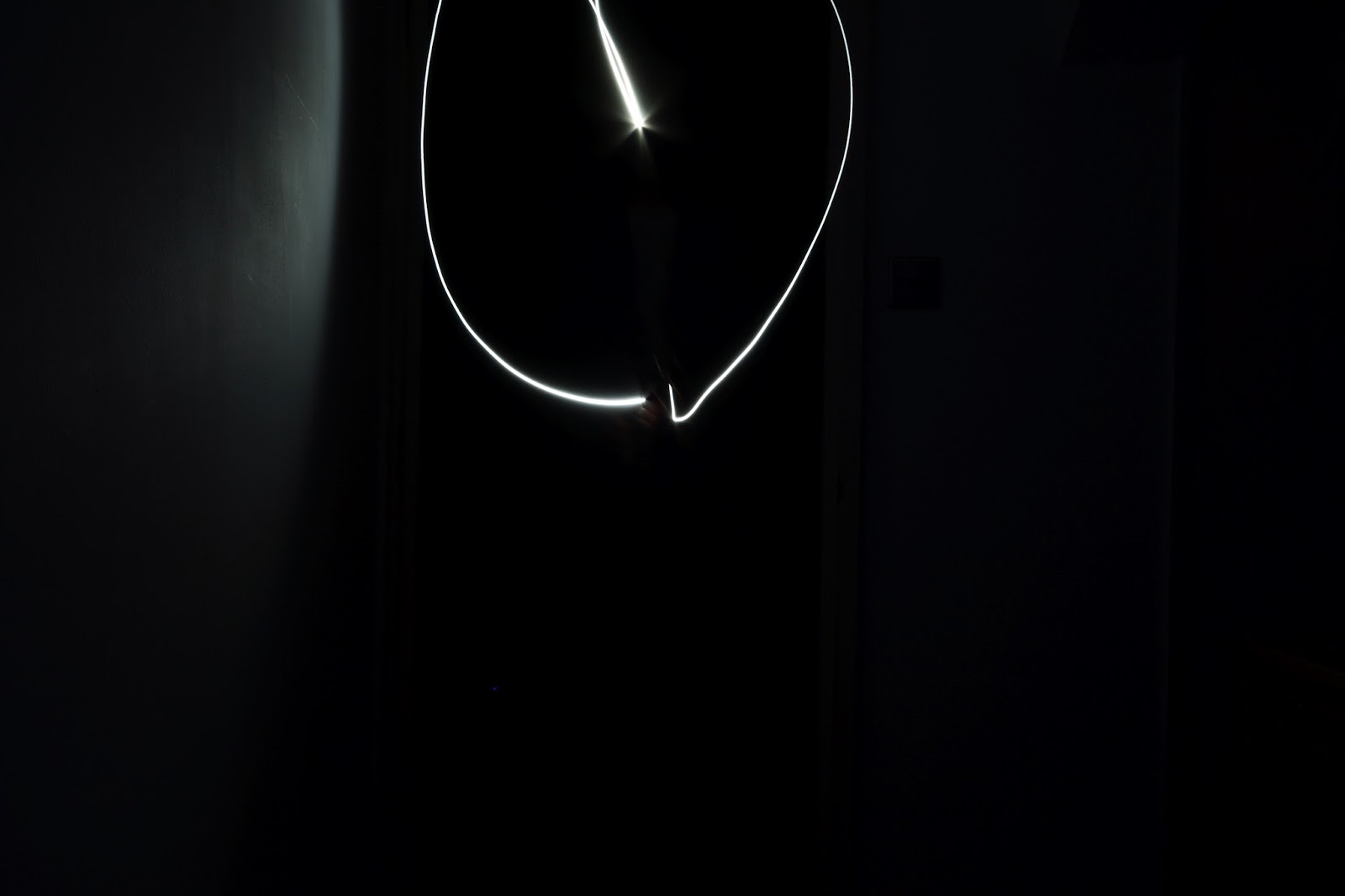
Painting With Light

Here's one hot off of the press for you. These pictures have literally just been taken and are still a bit wet so handle with care.

For a few weeks now I've been meaning to try out a new technique known as light painting. This is basically where you black out a room, or go out at night, and then use a long exposure and a torch or other light source to paint an image of some kind. This is basically my hallway (I couldn't use the front room because Sue wanted to watch Men In Black) with me sat on the floor using a mixture of phone and iPod to 'paint' with. I set up the remote within reach of Sue and got her to control the exposure in bulb mode which basically means she pressed a button every time I yelled Now! She was thrilled to be my assistant for this.

Anyway, after a lot of trial and error, I almost managed to get something passable. The trick lies in being able to visualise what you've already painted because you can't see it. I also needed to learn to cover the light with my hand to, effectively, take the pen off the paper so to speak. There's definitely a knack to this. I've thrown in one or two of my botched attempts and I need way more practice but hopefully you'll be able to see what I was aiming for. And thank you to Sue for being my glamorous, sofa-based assistant.

A woeful first attempt


This heart is a bit abstract but you get the picture


Smiley face? Just.


Saturday, 21 January 2012

The Lea Valley


The ArcelorMittal orbit

Over the past 6 months or so as I walk to work I've been able to watch a strange structure slowly rise up out of the ground on the Olympic site. Now, I'm no fan of the Olympics but I do like interesting architecture and, living just a few hundred yards from one edge of the site, I've been able to watch a lot of building work in the last 5 years. Aside from the stadium and other main venues there have been bridges built, canals dredged, roads widened, stations redeveloped and railway track laid; being a bit of a geek I really enjoy watching these sorts of things develop as I walk or ride by. I like to watch the process, stage by stage, note the sequences, watch the people and observe how order is slowly borne out of seeming chaos. It was a treat then to see something so unusual as the Orbit emerge so close by.

This image is a panorama of three photos stitched together. Click on it to panorama-fy it up a bit

The Olympic site, which will be known as the Queen Elizabeth Olympic Park once all is done and dusted, is situated in the east end of London on what was largely an industrial area in years gone by. From my point of view the main item in favour of the Olympics has always been the redevelopment of this land into what should eventually be a pleasant and green space, which is always good. Criss crossing the whole site is the river Lea and the associated canals that used to supply the industry of past. Linking this area to other patches of more natural looking life is a route known as the Greenway. This stretches from the Royal docks further south on the Isle of Dogs (not only is this no longer an island but no one seems to be quite sure anymore as to the dog reference either) up through West Ham and Plaistow into Stratford, where I live, and on into Hackney. It's a sort of ribbon of green that picks it's way through the city and, as you walk along it, if you don't look too closely and avoid the horizon you can almost fool yourself that you're taking a turn through the countryside. Almost. Maybe a small town.


This looks more like the nice end of my home town than the edge of Europe's biggest building site
The route is almost entirely raised up on a large bank that gives away it's heritage upon closer inspection: it's a sewer. But not just any sewer. The Great Stink of 1858 and the cholera outbreaks of the same decade were what instigated legendary Victorian engineer Joseph Bazalgette to construct London's famous sewerage works. The Greenway rides atop the Northern Outfall Sewer which is responsible for taking all of north London's waste down to the Thames at Beckton. At the time it still wasn't common knowledge that cholera was caused by a bacterium, the sewers were built solely to remove the stink which happened to result in the water quality improving which got rid of the cholera.


Okay, I can feel myself getting over excited now so I'm going to stop talking about sewers. The point is that there are thin veins of greenery threading their way through what is normally considered a pretty grim part of the city and they're really quite nice. They are also currently the closest you are allowed to get to the newer building work (barring special events) passing within just a couple of hundred yards of the new stadium - near enough to hear builders guffawing with laughter when something large and expensive sounding got dropped.

I exposed for about 1/3 second to get the blurring effect on the water
So, for more than five years I had been living in the Lea Valley and completely ignoring it. This has clearly been a mistake. As my wife and I left the Greenway and started following the canal around the north of the Olympic site we managed to forget that we were right on top of a vast construction site. With the stadium and Orbit out of view behind us we were just left with one and two storey residential buildings, the tranquillity of the slow moving water and the ducks and swans that made it their home.

Even the water ways here that look natural have been heavily modified by man's hand. The river has been 'canalised'; which basically means it's been levelled off, made a bit straighter and generally made more navigable. Whilst on the walk I spotted that some signs said Lee and others Lea with no apparent rhyme or reason. Investigations revealed, though, that the parts that are still fairly untouched are still called Lea, whereas man-made sections and modifications are distinguished by being called Lee. Neat.


One of the great things about canals, asides from their history and functionality, is that they tend to be rather still; combine that with a windless day, like we had, and that means you can get some very nice reflections in the water. The above shot was at a sort of T-junction that was more open than most areas and therefore the water was more disturbed but I still loved the reflection from this construction site.


Another reason why I enjoyed this little excursion so much was that it was an opportunity to get out with my new camera. I bought a Sony A65 in the January sales and am very impressed with it so far. I wasn't sure at first as it's an SLT camera, not an SLR, but it has more than held it's own and is definitely opening up some new avenues for me. I won't go into any more detail here, I'll probably give it it's own post in the near future and clearly label it as a techy sort of post so that those not interested in geeky detail can skip over it. I'll be doing the same with a post on digitally incorporating textures into images at some point too.


The old canal with traditional barges moored and the 'Gherkin' rising up on the horizon
A couple of hours of walking took us two thirds of the way around the Olympic site and from there we got the train home. I suspect I shall be spending a lot more time walking along these canals this year. I think a wander down to the Royal Docks on the Greenway wouldn't go amiss either. Home just got a little bit nicer.


Monday, 26 December 2011

Winter Wonderland

Hey y'all! Hope you all had a great Christmas and are looking forward to the New Year. We've been eating left overs all day yet seem to have more in the fridge now than when we started. Between work and the festivities it's been a while since I posted anything up here so I thought I'd better sort that out.


Last week I met up with some family and, amongst other things, we went to the Winter Wonderland on the corner of Hyde Park. It's basically a big fair ground with an ice rink, loads of places to eat and Zippos' Circus (which was awesome). All of these things were festooned with bright lights, often rapidly moving, and this provided a good opportunity to mess around with long shutter speeds. The pictures above and below had exposures of about half a second. As they were taken hand held and very much on the fly they are pretty blurry; however, the effect of the lights on the rides streaking brightly through the frame more than make up for the technical shortcomings of the shot, I think.


The next two shots were even more ad hoc. A bunch of us went on the Fun House which, asides from being a lot of fun, was actually quite perilous for my camera; all the moving walls and bits of floor led to it taking a few knocks. Still, I got these interesting looking photos out of it. There was a curtain of lit plastic tubes that you had to walk through and I just fired off a few frames as I went through. I wasn't even aiming so I can't take any real credit but I do really like the way they turned out. They're both quite abstract and the second one makes good use of negative, dark space which contrasts nicely with the brightly lit tube. The first one brings to mind those weird bio-luminescent creatures that are found in the depths of the sea; the tentacles of a carnivorous jellyfish maybe.


If I can get back to another fairground when I have time to use a tripod then I think there's real potential here for some imaginative work.

In the coming weeks I'll be finishing off a last few posts on my trip to Vietnam last year and I'll also come up with a post on using textures in photos. This is a post processing technique that blends images together to create a antiqued feel to your pictures. More next week!