Showing posts with label birds. Show all posts

Tuesday, 18 August 2015

El Condor Pasa

A novel new method is being used to help sustain a wild population of Californian condors: electroshock therapy. No, that isn't a typo. Twice per year all of the 150 or so remaining birds are captured and electrocuted. It isn't just for kicks, however; over the past decade the biggest single killer of north America's largest bird was death by electrocution after flying into power lines. With a 3 metre wingspan they are more than capable of touching more than one wire at once and being killed; touching just one at a time is relatively safe as the electricity has nowhere to go. Since the introduction of the training death by electrocution has dropped from 66% to just 18%.

The next biggest killer is lead poisoning, thought to be as a result of eating carcasses that have lead shot in them after being hunted by humans. The condors seem to be particularly susceptible to lead and so on their twice yearly grounding they are checked over and operated on if necessary to remove shot. Apparently a ban on lead shot in the area has not led to a reduction in mortality.

This all sounds like quite an arduous experience for the birds themselves but it's probably not as bad as it sounds. In the 1980s there were only a couple of dozen birds left in he wild, at which point they were all captured and brought into captivity. Since then there have been a series of reintroductions back into the wild that have been the genesis of today's 150. As these birds were all born and raised in captivity it's more like visiting home than being abducted by aliens.

The program, as reported in Biological Conservation, is working. In the past 15 years the annual mortality rate has fallen from 38% to just 5.4%, a remarkable achievement. Will this be a large enough population to sustain a genetically diverse enough species in the future? Only time will tell. I recently read an analysis by a genetic statistician that said that, given perfect conditions and full control of who breeds with who, it is very tough indeed for a population smaller than 160 individuals to survive, but we'll never know if we don't try

Californian condor, conservation, extinction
A Californian condor complete with tracking tags in both wings


Wednesday, 24 July 2013

Monday, 10 June 2013

Thursday, 3 January 2013

365 Project: Photo 003

Today at work, for reasons I'm not 100% sure about, a work colleague had a peacock feather that had made it's way over from India; I think it might be for her upcoming wedding. Apparently you're not actually allowed to buy peacock feathers there so she got her visiting parents to just keep their eye out for one that had fallen by the wayside, and this is what they got. Very pretty. We have a vague plan to go to India ourselves in the spring, I'll keep an eye out for one of my own.

peacock, feather, India, Hindu, sanskrit


Saturday, 29 December 2012

2012 Round Up

As the end of the year draws near we approach that time when journalists the world over start getting all retrospective and nostalgic about the passing of another 12 months. Whilst it seems like this is a reasonable enough tac to take the reality is that it is a quick, easy and lazy way to generate another week of output on the cheap; and who am I to argue with such a proud tradition? So here, having gone to absolutely no effort whatsoever, are a collection of some of the better photos from the blog over 2012. Some of them are taken from the most popular posts of the year and some of them are just ones I like. Normal service will resume in the New Year. Enjoy!


This is one from a post on how to incorporate textures into images, the photo itself is from Porto.


This shot of Tower Bridge could be improved by returning early morning when the sun would be off to the left and less harsh.


This close up of a leopard is from a post on abstracted animals.


Although the town itself is forgettable Tulum is one of the most impressive archaeological sites I've been to.


Chichen Itza, the second most visited place in all of Mexico.


This shot of a hummingbird is a bit out of focus but was the best I managed to get and the culmination of a lot of effort.


I just love the colour palette in this picture.


Sunset on the South Bank: heaven.


From the same post as above, once the sun had gone down we went to the top of One New Change for this amazing view of an icon of London.


This panorama of Mount Esja is quite beautiful when viewed blown up, even if I do say so myself.


This is one of Sue's favourites from our trip to Vietnam.

Sunday, 9 September 2012

Pelicans

Namibia, Swakopmund, pelicans, cape seals
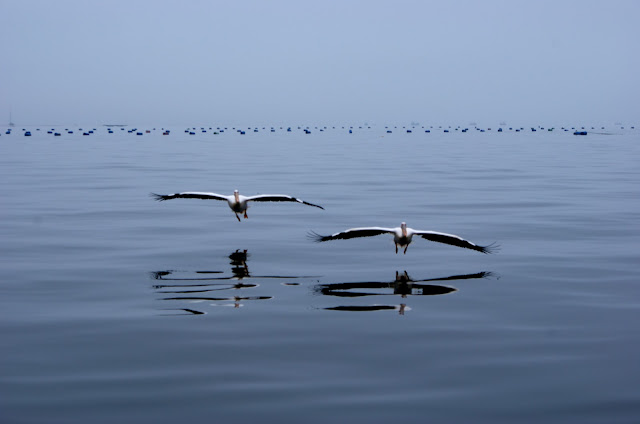
The blue buoys in the background are markers for an oyster farm

Here is a set of images I took nearly three years ago now of a pair of pelicans coming in to land. My wife and I were in a small boat off the coast of Swakopmund, Namibia and the pelicans knew that if they came and said hello they would be rewarded with a few choice mackerel. Taken together the three images give a great sense of the grace and control these birds have as they come in to land, but, we almost missed the opportunity all together....

Namibia, Swakopmund, pelicans, cape seals

The town of Swakopmund, (one of my favourite place names of all time, right up there with Saqsayhuaman and Fingringhoe) can be found about half way up Namibia's long Atlantic coast line almost directly west of the capital Windhoek. It's a curious little town, a bit like, I imagine, stepping back into 1970s East Germany. Not in a Stasi, Eastern Bloc kind of way but in a way that brought to mind what Germany might have been like without the burden of mass industry and high technology. You see, during the Scramble for Africa we got South Africa, Egypt, the Sudan and others; Belgium got what is now the DRC; the French got much of the north west of the continent and Germany got a portion down in the south west of Africa which they called, with typical Teutonic imagination, German South West Africa, now known as Namibia. The result of this was a little slice of Bavaria in the desert on the opposite side of the world.

Streets in Swakopmund have names like Nord Ring, Heuschneider and Mittel Straße and it couldn't be easier to find a cold, European style beer and a stein to drink it out of. Nationally, one third of white Namibians speak German and this proportion is thought to be higher still in Swakopmund. So, pretty German, then. It was for this reason that we were rather worried that we were going to miss our boat trip as Germans don't tend to be keen on tardyness. You see, we were under the impression that we were going to be picked up from our awesome accommodation and taken the 20 miles or so down to Walvis Bay where the trip began; but more than 20 minutes after we expected to be picked up we found out that we were going to have to make our own way there and average a mile per minute in the process. We were on a driving holiday, doing a lap of Namibia and so we had our own wheels but this was still less than ideal. We covered thousands of kilometres on that holiday and more than 90% of it was on gravel roads; luckily this little stretch was 100% lovely black top.

Namibia, Swakopmund, pelicans, cape seals

With Sue doing her best Jensen Button impression we made it. Just. But it cost us some light ribbing from the boat load of middle aged German tourists that seemed to punctuate our way around the country, Namibia being quite a popular tourist destination for our Germanic cousins. The main point of the trip was to see the enormous Cape Cross seal colony and, if we were lucky, dolphins; we knew the pelicans would be there but we didn't give them much thought. As we saw them come gliding into view though, through the early morning mist over a perfectly still Atlantic, they had an undeniable majesty to them that let me easily capture a great little series of images.

Another highlight was when a, presumably semi-tame and well rehearsed, male seal climbed up the back of the boat and onto the deck. Now, we were not on a large boat, she was only about 20 feet from bow to stern so to have a 9 foot seal weighing a third of a ton lumbering about was, I admit, a little disquieting. All of a suddenall the human cargo had to pin themselves to the side railings to give this behemoth room to, well, generally stink the place up. If I'm honest, my lasting impression of this encounter nearly three years on, once you've got used to the enormous size and very pointy looking teeth, is that seals really, really stink of fish. I guess he was quite cute in his own way, and he certainly seemed to appreciate his free breakfast.

The last picture I'm going to show you from this trip was one I caught on the fly, so to speak. It still cracks me up every time I see it. I would say that this shows pelicans looking slightly less graceful than in the previous photos and if you look carefully you can just about see a fish below it's beak that had been thrown for it to catch.