Showing posts with label Europe. Show all posts

Sunday, 5 July 2015

Dungeness: Black and White

Back in April I met up with a couple of fellow camera nerds, comrades from the 365 Project, for a trip down to the south coast. We were going to Dungeness, somewhere I had long wanted to photograph. I had looked into going there before but without a car it is prohibitively difficult; public transport doesn't best serve such areas. And they can't really be blamed, its own promotional website describes Dungeness as 'bleak and desolate'. This wasn't what was on our mind, however, as we headed progressively south. The weather was wonderful, one of the first truly beautiful days of the year. Sadly, it didn't last. By the time we had arrived the cloud had solidly set in and the exposed nature of the area left us open to a biting wind that soon left my ears stinging. Undeterred we set off to explore.

black and white, photo, boat, beach, shingle, england, bleak, wood, stone,


Anyone vaguely into landscape photography in the UK will be aware of Dungeness as a location unlike any other in the country. Basically it is an enormous bank of shingle, the largest on the continent. At a glance it is as bleak and desolate as advertised but upon closer inspection there is actually a lot going on. It is a part of a vast nature reserve that is particularly important with regard to bird and plant life, in fact it is home to one third of all the plant species to be found in the UK. There are also two nuclear reactors, Dungeness A and Dungeness B, the first of which has been shut down and the second of which is due to be so in 2018.

black and white, photo, boat, beach, shingle, england, bleak, wood, stone,


Although from a comfort perspective this was not going to be the most wonderful afternoon, from a photographic perspective it was pretty much exactly what I'd hoped for. It was Dungeness at its gloomy best. What little colour there already was had been further muted by the grey clouds and so tones and textures became ever more important. There was always going to be a lot of black and white conversions in post processing after this trip. A little tip, even if you fully intend to end up with black and white pictures it is generally a good idea to originally shoot in colour and then convert to black and white. This gives you a lot more options after the event in what type of black and white you want to apply and, of course, in staying in colour if you so choose.

black and white, photo, boat, beach, shingle, england, bleak, wood, stone,


The main photographic focus are the numerous abandoned fishing boats that sit just above the high tide mark in every imaginable stage of decay. There are a few where it's actually difficult to tell whether the boat has been left for dead or whether it's still a living, breathing boat; and then there are others where all that is left are the ribs of the hull and a few warped planks like the skin on the corpse of a rotting whale corpse. There are also tiny little railway tracks and wheelhouses that, once upon a time, were used to haul the fleet up and down the beach. The tracks can provide leading lines to help guide the eye around a carefully composed image.

black and white, photo, boat, beach, shingle, england, bleak, wood, stone,


I'm going to post a second Dungeness article full of colour images, there were a couple of occasions where having a splash of vibrancy was the right path to take. Our final path led Rachel, Christin and I to a local pub where we could warm up and refresh before the long drive home. I'm very happy that I finally made it down to Dungeness, it was a photographic and social success; I highly recommend it to those with a bleak streak running through them.

black and white, photo, boat, beach, shingle, england, bleak, wood, stone,


Saturday, 3 January 2015

The Milky Way

On my first night of this particular trip to Romania last summer I got excited. As we were driving to my girlfriend's dad's house (personally I'd call it a farm), I looked out of the car window and saw stars. Not just a few like you get in London, but hundreds and hundreds of them; maybe a couple of thousand. And stretching out across the heavens, as clear as day, was the Milky Way. This wasn't the first time I'd seen it; I'd seen the galactic disc in lots of different places around the world and I've even been able to see it in the UK a few times; but this time I knew that I was going to be here for a couple of weeks and there should be plenty of opportunities to get some good pictures. I was excited.

One night when I had a spare hour or two I took the camera out onto the road beside the farm, I knew there wouldn't be traffic any time soon, and started taking a few tester pictures. First of all I decided to try and get a shot of stars with the landscape included for perspective. There were trees and a few farm buildings across the way. It wasn't easy as there was the odd streetlight here and there that made the exposure difficult to get right. The results weren't great but I wasn't too bothered as I knew this was just the preamble to the Milky Way shots I was going to get later.


Having got a fairly mediocre picture I moved round to the side of the farm where it was even darker and there were fewer lampposts. Now I was aiming almost directly up in the air to try and get a picture of just the Milky Way with nothing terrestrial in frame. The first few attempts were promising and not too long later I had the shot I had been waiting for. It looked great. The galaxy was clearly defined arcing right through the middle of the frame, the stars were bright and pin sharp and I knew I had a keeper. I was excited to think how it would look once I'd processed it a little to make it even clearer once I got back to Blighty. You can see the finished result below.

milky way, stars, astronomy, romania


Pardon? What's that you say? You can't see anything? Am I sure I uploaded the right picture? Yes, I'm sure. Hmmmmm.... The problem seems to be that what I saw on the back of my camera that night was not representative of the data the camera captured. I can't really explain what went wrong but it goes without saying that once I got home I was very disappointed to see the result as, as you can see, it's rubbish. There is basically nothing there. I tried to process it every way I knew how but it seemed beyond rescue. I was gutted. I have posted it here anyway mostly just as a warning, I suppose. You can't always trust exactly what you see in camera. My advice would be to make sure you always check the histogram, especially if you're working in extreme light conditions, as this should give an unbiased account of the data you've captured; and keep taking pictures, even if you think you've got 'the one'. I hope you have more luck than I did.

Sunday, 28 December 2014

The View From St. Paul's


London, St. Paul's, cityscape, photo, landscape, capital, sky, clouds, city of london

A few months ago my mother came to visit. She wanted to visit St. Paul's cathedral and climb to the summit, and so we went. On that occasion I just took a few snaps on my phone but I returned a few weeks later, awesome annual pass in hand, to try and get some decent clicks with my proper camera. Unfortunately the weather was against me. The photo above has been quite heavily processed to try and make the best of the sky; I've gotten quite lazy and you can see halos (no pun intended) around the buildings on the horizon. I also need to clean my lens and sensor. Below, I've deliberately gone for a silhouette type effect to mask the fact that otherwise it would be quite an underwhelming picture.

Still, I've learnt a lot about the location; I know what sort of shots I want to get, what time of day I need to be there to have the sun at the best angle and, like I said, I have an awesome annual pass and so I'm going to keep going back until the weather is in my favour. God willing.

London, st pauls, silhouette, clouds, sky, the shard, cityscape, landscape, photo

Friday, 14 November 2014

Quintessentially English

Capstone, Ilfracombe, water, sea, cliffs, grass, sky, statue, coast
Atop the Captsone
A few weeks ago I had the absolute pleasure of giving a friend away. No, not at some sort of charity car boot sale; it was at her wedding. She had had the good judgement to get married at Tunnels Beaches in Ilfracombe, Devon. Not only is it a fantastic venue in which to get married with views out to the Irish Sea and your very own private beach to explore, but the town of Ilfracombe itself is a very picturesque one. Having spent 6 hours on a coach getting there after work I was keen to get out and about the next morning. As luck would have it my hotel was just opposite the Capstone, as locals call it, or as you and I might, the big cliff thing.

church, silhouette, sky, spire, clouds,

Freshly fueled with eggs and bacon I charged up to the top as fast as my little legs could carry me where, at the summit, I was rewarded by fantastic views in all directions. To east and west were views of the coast and cliffs, and to the south all of Ilfracombe was laid out before me. The terrain is hilly and the bulk of the older part of town nestles in a valley running parallel with the coastline; some newer developments have followed the valley as it kinks south. Very little land is wasted, the hills are steep and so many streets are terraced, clinging to the sides of the slopes as the terrain permits. The result is lots of little blind corners, narrow alleys and sudden inclines that frequently put me in mind of the time I spent in south Wales as a child; which shouldn't be so surprising given the two are only separated by 30km or so of water. Indeed, the hotel played Welsh radio in the dining room, which rather threw me as I hadn't undergone the normal mental preparation I would customarily go through before returning there. Also at the peak was the statue in my photo at the top of this post, although I'm afraid I must confess that I have no memory of why it is there or what it represents. I can say that it does a good job of conveying the energy and movement that is so evident atop the cliffs there.

Landmark theatre, Ilfracombe, water, sea, sky, coast, hills, cliffs
The Landmark Theatre, at bottom left, tends to polarise locals; they either love it or hate it.
My time in Ilfracombe was short but very pleasant. I have been to that part of Devon before and will happily return again in the fullness of time. I don't get to the coast as half as much as I would like which is a shame because the UK is blessed with hundreds of miles of beautiful coastline. I must make sure I don't neglect it so in the future.

Sunday, 19 October 2014

Vertical Abstraction

abstract, photo, photography, romania, mamaia, constanza, constanta

Whilst I was in Romania this summer I went to the beach resort of Mamaia a few times, largely considered to be the most popular beach resort in Romania, the whole resort is squeezed on to a spit of land 8km long but only 300m wide. On one of my trips there I rode the cable car back to Constanza, it takes about 7 minutes to cover the 2km distance. Although it's a bit pricey it does afford some good views of the area and saves you having to wait for the bus/walk/swim.


Like most cable cars, indeed like most other forms of transport, if you want to take any pictures you either have to get what you can through a tiny, inconveniently placed open window, or, shoot through a half inch of scratched, dirty plexiglass covered in the spit of a thousand window lickers. Neither option is ideal.


Inevitably, this was the situation that faced me. My highly creative and completely lucky resolution was to blindly fire off shots aimed straight down to the ground. Obviously I could see roughly what was coming up; a waterpark, residential blocks and so on; so it wasn't 100% chance, but it was mostly.

The one exception to this was the picture of the residential block. The setting sun gave it a wonderful orange glow that added to the already decades old feel of the building.


Sunday, 16 March 2014

The Lomo Effect

Well it's been a few weeks so I thought I'd better come up with something for the blog and, so, I've investigated the Lomo style of photography and come up with a little guide on how to take a bog standard snap and give it a bit of the old Lomo magic. 

For those of you that haven't heard of it I should probably describe what the Lomo style, or Lomography, actually is. I guess it's actually two things; one of which is easy to define, the other of which isn't. The easy one is the physical look of the photos; there tends to be a vignette (darkening at the corners), the colours are very rich (due to the use of slide film and the common practice of cross processing the negatives) and the quality is generally low with blurriness, poor exposure and even light leaks frequently featuring. Most of these properties, normally avoided at all costs by most photographers but sought out by the lomographer, are down to the very low build quality of the lomo camera. Think 1980s, Russia, plastic.

The element that is more difficult to pin down is the style and composition. Perhaps a good place to start would be with the motto of the movement: Don't Think, Just Shoot. Although it could easily be confused with the motto of the American military it is actually a style encompassed by The Ten Golden Rules of Lomography as laid out on their website. These include such adages as Take Your Camera With You Everywhere You Go, and, Lomography Is Not An Interference In Your Life But A Part Of It. Basically, they try to encourage you to break every traditional rule of photography that ever existed. The Rule of Thirds would be anathema to a lomographer. I highly recommend a look at their site to get more of a feel for this unusual brand of photography; you'll probably either like it or you wont.

The question is: how did such an odd, counter-intuitive and niche movement even get started, nevermind become an international phenomenon? It all started as recently as 1992 when a group of Viennese art students came across an old Lomo camera whilst on a tour in Prague. They found it in an old camera shop and used it in a very casual kind of way, often not aiming, shooting from the hip and generally just mucking about. Upon returning home and developing the film they were charmed by the "unique, colourful and sometimes blurry images" that were produced. Interest amongst friends and family rapidly grew and the following year they founded a society in honour of the strange new camera. The camera in question was a Lomo LC-A Compact Automat, produced some ten years previous in the USSR. The build quality of the device was.... well, there was no build quality; but this leant itself perfectly to the students shooting style.

There was a problem, however; with the fall if the USSR also came the end of the production of the camera and the prospect of a ready supply of the student's new favourite toy. Undaunted, the students flew to St. Petersburg, where the Lomo factory was located, to make a deal for tax breaks so as to make it economically viable to continue production. They successfully got the special permission required from the mayor of the city, a very amiable and friendly chap, one V. Putin. The rest, as they say, is Lomography. Production has since shifted to China and production continues to this day; the future of Lomography seems secure and Lomo cameras remain cheap and affordable for all to try. The film is now the increasingly expensive part.

But what if you don't want to faff about with film and developing and such like and just want to create the same effect using your existing DSLR and a bit of canny processing? Well, I'll show you how - so long as you intend to use Adobe Elements, although many applications are broadly similar these days. Those of you not interested in the technical parts can just skip to the pretty picture at the bottom.

photo, style, lomo, lomography, lomograph, railway, train track, trees, sky, grass

The picture we're going to start with is no great shakes. The exposure isn't great, I should have got my neutral density filters out, the sky is overexposed and there's some lens flare; but as we're aiming for the Lomo style none of this should matter, if anything it'll help. So there are two main things we need to do here; create a vignette and achieve a cross-processing effect by increasing saturation and contrast. There is more than one way to do each of these steps including just clicking through the guided Lomo Camera Effect wizard, but where would the fun be in that?

There are two easy ways to create a vignette. The first is to simply go to Filter>Correct Camera Distortion and use the sliders in the vignette tool, which are normally used to remove a vignette, not to create one. I'd normally go for somewhere around -40 to -50 but it's totally up to you.


The second way is a little more involved but gives you more control. Take the Lasso tool and, having selected a feathering level of, shall we say, between 100-200 pixels, draw a vaguely circular shape in the middle of the photo. Again, we're not aiming for perfection here. We want to alter the outside of this circle not the inside and so you need to click Select>Inverse. Now create a Levels layer and slide both the shadows and the midpoint markers to the right a little, this will add to the vignette effect. I actually prefer to use a combination of these two methods to make my vignettes.


That's the vignette sorted but now we need to work on the distinctive colour palette of lomography; again, there are a couple of ways to go about this and I like to use a combination of each. First up: colour curves. Click on Enhance>Adjust Colour>Adjust Colour Curves... (yes, it really does have the three little dots after it). Here you are presented with a straight diagonal line on a grid. The left hand side of the grid represents dark colours, the left hand side highlights, and the middle is the midtones. There are several preset options available but you can also drag the points on the line to warp it. Moving any given point on the line either up or down will make the corresponding band of colour more or less intense. We want to make the curve look like an S; this will have the effect of making the highlights brighter and the dark parts darker, i.e. increasing contrast. If your line looks something like the one in my example below then you're on the right track. Press okay when you're happy with the effect achieved.


I would also recommend increasing the saturation, this will help to achieve the cross processing effect that is so synonymous with the Lomo style. To do this you can either click on Layer>New Adjustment Layer>Hue/Saturation... or simply click on the button with the diagonally divided circle on it on the right hand side and select Hue/Saturation... Use the slider for Saturation to give your colours a bit of a boost. For a 'normal' photo I wouldn't want to push this much past the mid teens, but for the Lomo style you can probably get away with numbers in the 30s, 40s or even higher depending on the photo.


In the same way that you got your Hue/Saturation... layer you can now select a new Brightness/Contrast... layer. Here, I wouldn't say that the Brightness has to go one way or the other, this really depends on what look you want to achieve with any given individual photo, but I would recommend increasing the contrast a little.


Lastly, I would say it's worth while putting a Fill layer in. To do this, select Layer>New Fill Layer>Solid Colour... Call the new layer whatever you like or leave it as the default and click Ok. This should default to a layer of pure black and you will completely lose the picture you have so carefully created. Fortunately it is only hiding behind the black layer and we now have to blend the two together to reveal the finished product. Click Ok again. At the top right in the Layers panel you will have a drop down box with various different blending options; I would recommend Soft Light or Hue or Saturation and an Opacity of something like 30-50%. This should really help bring about that cross processing look. Cross processing, by the way, is where you develop film using non-standard chemicals. There are two main film types; standard 35mm and Colour Slide film. Each of these sets has their own chemicals used in their development, C41 for 35mm and E6 for Colour Slide film; however, lomographers noticed that you can get some really cool results if you swap these up. As I understand it the more common option is to use Colour Slide film and process it with 35mm chemicals.


That's about it. With any luck you should now have a photo worthy of the annals of Lomography, or at least something that looks a little old timey; you can see my effort below. None of the techniques I have mentioned here are set in stone; indeed, that would go against the whole freestyle notion that made Lomo popular in the first place. The idea is not to be constricted by the traditional norms, to break the rules and not to worry about the consequences. As Rule #10 of Lomography says: Don't worry about any rules.

photo, style, lomo, lomography, lomograph, railway, train track, trees, sky, grass

Sunday, 5 January 2014

Review of 2013....

Soooooooo, it has been rather a long time since my last post. This has been due to a number of reasons, partly laziness, partly lack of inspiration and frustration with the 365 Project, and partly because I have been in Romania for the last 3 weeks and internet connections there were few and far between. I will finish off the 365 Project, I have a bunch of photos on the back burner that I need to process and get written up and I will try to have that done by the end of the month. For now, I'm going to do one of those lazy Review of the Year posts with some of my favourite pictures from 2013. I won't include any from the period I haven't posted yet, you'll just have to be patient for those.

In 2014 I will be going back to my usual format of a post every fortnight or so. I think this gives me time to get some decent photos together and the words to go with them. I think the daily requirement of the 365 Project ultimately lowered the quality of what I do here, which was one of the reasons I became increasingly disenchanted with it. However, this does not foreshadow the year ahead, I am optimistic and enthusiastic about the blog for 2014. I have had 70,000 hits so far which is orders of magnitude more than I ever expected and so thank you to everyone who takes time out of their day to see what I've been up to. I'll try to raise the bar.

The last 12 months have been the most traumatic and difficult of my life, much of it self-inflicted, but there were certainly some good times too. Thank you to everyone who has stuck with me this far.


Gargoyle from inside the Natural History Museum, January.


View from Westminster Bridge, January.


Chain in Vienna, March.


St. Marco's piazza, Venice, March.


Venice, March. 

 
Parliament Square, London, May.


Pocketwatch, May.


Parliament Square, London, May.


 Dead flower, July.


 Olympic Park, September.


Thursday, 19 December 2013

365 Project: Photo 354

The journey continues....

Germany whizzed by at a great rate of knots but unfortunately we had a little more trouble once we got into Austria. It turns out the driver didn't know how to use the sat nav properly and he had merely plugged in the final destination and let the device do the rest. This is one of my major bug bears with sat navs, they stop people thinking. The mistake he made was to say that he wanted to avoid toll roads, this meant that instead of cruising along the E60 motorway avoiding the mountains we ended up snaking our way through mountainous back roads in the middle of the night. Along with the fog and the constant blind turns you might be forgiven for thinking that what you shouldn't do is drive in the middle of the road. This, apparently, is the safest way to negotiate such a route but having had to swerve back onto our own side of the road a few times I found myself strongly disagreeing with this philosophy.

After a couple of hours of this meandering at 20-30mph we eventually stopped for fuel at which point I leapt out of the car and bought an atlas. I eventually managed to pin down where we were and led us back to the E60 but the whole time the sat nav was forever telling us to get off the road. I insisted on being given the wretched thing and reprogrammed it, properly this time, and we soon made good progress through the rest of the country. Dawn brought Hungary which whizzed passed without mishap.


Since getting off the ferry in France the borders between each country have been non-existent. If you didn't keep an eye out for the sign announcing the frontier then you would never know you had passed into another country. There were no barriers or gates, no tolls or customs and no need for anything as archaic as a passport.

All that changed when we got to Romania, however. All of a sudden everything ground to a halt. Perhaps because they only get one car all day to look over the border guards decided that they would make the event last as long as possible. I wouldn't have expected three Romanians and an Englishman to have too much difficulty getting into Romania, but there were questions aplenty and the need to go to the little hut off to one side to pay the 'tax'. Once we were finally on our way again the going was a lot slower than it had been previously. Beautiful, slick, black tarmac gave way to pitted, gravelly tracks. As we crossed a wide, flat plateaux dotted with villages and farmsteads the difference in  affluence between the people of Hungary and Romania was stark.

As I look back the main images I have of that area are of a dead dog in the middle of the road, frozen stiff and entrails being picked at by crows; and an old man (I almost want to say 'peasant') sat on a crate at the roadside selling some home grown vegetables on a blanket. It's fair to say none of the produce at hand would have passed the QC of a British supermarket. The people here were dirt poor and I feared that all of the worst stereotypes that many of us will have of Romania were true after all. As we progressed, slowly, we got to the city of Timsoara which, happily, looked like any other city; although the undercurrent of poverty never completely faded.

This picture was taken by Georgiana as I slept. We had eventually come across a good road that should have shuttled us down to the capital, Bucurest, but it appeared to be closed. The third and final fuck up of the journey was when it was decided that instead of following alongside the main road on smaller roads for a while and then joining it later, we started ascending the Transalpine road. This felt a lot like climbing into Narnia. The road was frozen, the trees were frozen, waterfalls were frozen; everything was white, cold and hard. After nearly thirty hours of non-stop driving I didn't feel that this was the best way forward; the road was single track, the tyres we had were completely unsuitable, the driver was exhausted, and the place was completely deserted. It could have gone very badly wrong. I was, however, overruled. I was so pissed off about this that I decided to try to sleep my way through it.

Wednesday, 18 December 2013

365 Project: Photo 353

Finally! We're back on the road! This was sunset as seen from a German autobahn. Our unplanned and lengthy stay in Brussels ended at lunchtime today when we picked the car up from the garage. Unfortunately/stupidly we had a bit of a run in on Saturday night on the outskirts of the Belgian capital. Our driver hadn't noticed that the turn at the top of the slip road we were leaving the motorway by was a right angle. He valiantly tried to make the turn anyway, at 60mph, but failed. We mounted the curb destroying the tyre and the wheel and damaging the suspension. This was at about 2am and, would you believe it, there wasn't a local garage just waiting to fix it for us. I won't go into details here but two and a half days later we're back on the road. Only 30 hours of driving to go!!


Tuesday, 17 December 2013

365 Project: Photo 352

Georgiana looks most unimpressed with the Pissing Manequin; and, yes, another photo from Brussels. Don't ask....


Monday, 16 December 2013

365 Project: Photo 351

What's that you say? Why have you posted a picture of the Hotel de Ville from the Grand Place of Brussels when you're supposed to be barrelling through Hungary by now? It's a complicated and frustrating story which will have to wait for another day...


Saturday, 14 December 2013

365 Project: Photo 349

Tonight I set off for Romania. We're going by car. Yup, driving the full width of Europe. It's about 2,700 miles and we're expecting it to take about 36 hours of actual driving time; about 40 hours in total. We don't intend to stop but for comfort breaks. This was my last view of Blighty as we chugged out of Dover headed for Calais. The rough route is France, Belgium, Germany, Austria, Hungary, Romania; the final destination being the town of Mangalia on the Black Sea Coast.

The sea was not exactly smooth as we pulled out and quite a few people were struggling to find their sea legs, Georgiana included. Even though it was raining and very windy I was very excited and insisted on spending as much time as possible up on deck. 


Wednesday, 3 July 2013

365 Project: Photo 184

I went for a walk along the South Bank tonight, and very pleasant it was too. The theme was Contrast. It doesn't get much more contrasty than a silhouette.


Monday, 25 March 2013

365 Project: Photo 084

Okay, I lied. One more from Venice. I love that you can see the texture in the stucco on this wall, and the colours are very soothing.


Sunday, 24 March 2013

365 Project: Photo 083

A final picture from Venice for today's effort. I'll try to get more on topic over the next week. On many of the bridges in Venice, of which there are many, you will find padlocks with the names of lovers written on them. I've given this picture of some of them the Lomo treatment.


Friday, 22 March 2013

365 Project: Photo 081

I'm totally ignoring the prompt today as I am in Venice and just using whatever I like. This is the view looking north from the Rialto Bridge in the centre of the lagoon.


Friday, 1 March 2013

365 Project: Photo 047

This is a little triptych I made of Michaelerplatz and Stephanplatz in Vienna. I grunged it up a bit using Snapseed and then used Photo Grid to make the montage.


Sunday, 2 December 2012

The City of Arts and Science: A New Beginning

Valencia, Spain, City of arts and sciences, opera house, science museum, hemisferic


I have a confession, and a grave one at that.

There was a time, not all that many years ago, when I used to believe in conspiracy theories. You know, like the JFK assassination and that the moon landings were hoaxes, I also thought there might be something to astrology, bigfoot and alien abductions; there was even a brief period when I was a 9/11 Truther.

It's all very embarrassing for me to admit to this. Just thinking back to those times makes me physically cringe. It's mortifying. I mean, each one of those things on its own would be bad enough but to go in for them all? What was I thinking? Well; I wasn't thinking. I now think that the various beliefs I held stemmed from a combination of factors: a lack of confidence, lack of critical thinking skills, misplaced faith in charismatic people I admired, a hefty dose of anti-American sentiment, reluctance to take responsibility - it's so much easier to blame the universe if your life isn't working out how you want it to, so much easier than working hard and applying yourself. But the truth is that the universe doesn't give a shit about me and my life. It was getting along just fine before I turned up and it will continue to do so long after I'm gone.

Valencia, Spain, City of arts and sciences, opera house, science museum, hemisferic
The DNA molecules I analyse at work are somewhat smaller than this

Looking back, one of the things I find most curious about it is how I was able to compartmentalise my thoughts. I was an intelligent person with a degree in genetics and yet still I spouted all sorts of rubbish in my spare time. I wasn't a complete fool, though; there were areas of lazy, illogical thought processes that I managed to shrug off quite easily. Despite pressure to fit into the Catholic mould I found that religion never made any sense to me. The first time I read the bible was as a child, religion never made any sense to me. I would read about a miracle and just think: well, how could that have happened? Omnipotence isn't a good enough answer; if nothing else it's just plain intellectually lazy. The second time I read it through I just found myself getting increasingly disgusted with the level of self-contradiction and hypocrisy crammed onto every page. And it's not like it's even original, it's just a collection of poorly told myths and rip offs as brazen as the Bronze Age that spawned them.
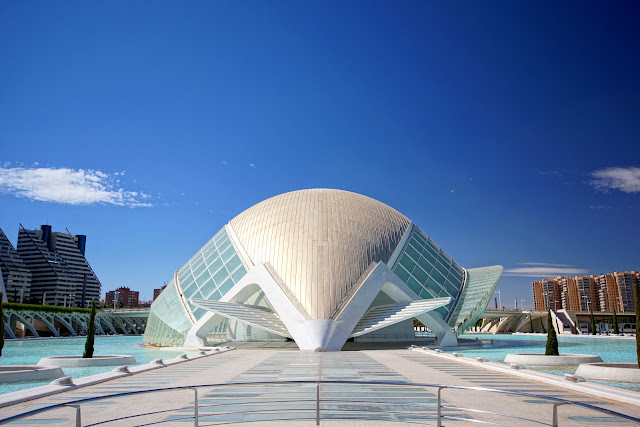
Valencia, Spain, City of arts and sciences, opera house, science museum, hemisferic
L'Hemisferic

For the life of me I can't remember what it was that made me finally shake off these mental shackles; it wasn't any one thing, I think I must have just finally started using my brain. Of the myriad benefits of my awakening I think my favourite is that all the space in my brain that was taken up by the obscene mental gymnastics required for fallacious thought, such as thinking that the US government could conspire to blow up the twin towers when they couldn't even keep a Presidential blow job a secret, is now free to be filled with something altogether more exciting and useful: science.

I was always a science geek, even as a young child but, embarrassingly far into my twenties, I had allowed it to cohabit with too much groundless nonsense and ideology. In the years since I have consciously learnt as much as I can about the fallibility of human reasoning, about the ways our brain can fool us, the way confirmation bias influences us, logical fallacies and the importance of the scientific method as the only tool we have to actually know anything for certain. All through my childhood, and even in the depths of my youthful intellectual transgressions, science has always been the topic that has got me most excited. Any and all science, I'll read anything I can get my hands on; not just the stuff I'm really into like genetics, astronomy and particle physics. The other day I lost an entire evening reading about the geology of spherules. I'd never even seen the word spherule before but as soon as I did I had to know as much as I could about it.

Valencia, Spain, City of arts and sciences, opera house, science museum, hemisferic
The opera house; a cross between the heads of Megatron and the Stig

When I first set up this blog, nearly two years ago now, I had to come up with a name for it. Travel, Photos and Thoughts is what I came up with. I deliberately left the word thoughts in there knowing that there may well come a time when I wanted to talk about more than the places I have gone to with my camera. To an extent, that time may be arriving. Due to a damaged foot I'm not currently able to get about all that much and I have taken very few photos in the last few months. As I write this I'm supposed to be going out with The London Photowalk group that I have written about previously but I am unable to do so and it could be many months before that changes. Whilst I do have a bit of an archive that I can draw on it won't last forever and so I need a strategy. My plan is two fold; to try and explore my local area more so that I can keep taking photos, but also to expand my remit, if only temporarily. I don't know exactly how it will work yet but it'll definitely still involve pictures although they may be taken by the Hubble space telescope, the Mars Curiosity rover or a fancy electron microscope instead of me. Let's just see how it goes.
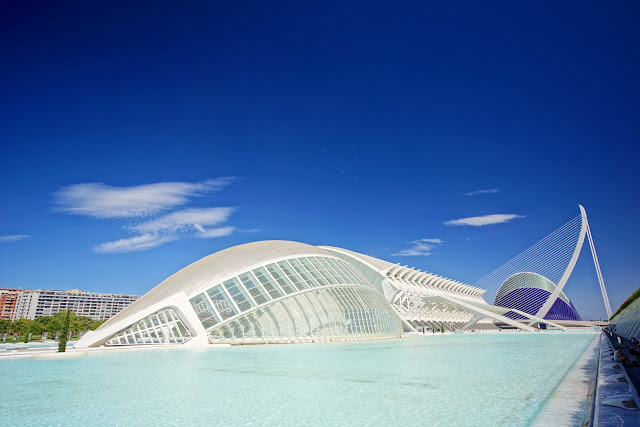
Valencia, Spain, City of arts and sciences, opera house, science museum, hemisferic
Giant space alien carcass?

Everything we know about the physical world - everything - we know through science. Combine that with our culture and the joy we find in the beauty of aesthetics and we have gone some way to identifying what distinguishes us from the rest of the animals, Art and Science. Which brings me, rather circuitously I grant you, to what was supposed to be the main thrust of this article: Valencia's Ciudad de las Artes y Ciencias. For nearly our entire history as a species we have been willing to move heaven and earth to move earth closer to heaven. For millennia, the pinnacle of human scientific achievement were the shrines we built to religion. The cathedrals of Europe, the pyramids of Egypt and Mexico, the temples of south east Asia; all required a massive amount time, effort, resources and scientific knowledge that was rarely applied to other fields of endeavour, excepting, perhaps, war. A century long building program would be embarked upon at a time when life expectancy was about 40 and no one would think this a strange thing to do. Although it all seems a bit mental now I, for one, am very pleased that they did because many of these structures remain to this day and are a long lasting testament to human creativity and ingenuity. But something I'm also very pleased about is that it is now not considered unusual to put a similar amount of effort and resources into the celebration of science and the arts; this is what has happened in Valencia.

Valencia, Spain, City of arts and sciences, opera house, science museum, hemisferic


For the 2,000 years that Valencia has existed the river Turia ran through it's heart, but the river was prone to frequent flooding and one particularly bad incident in 1957 left the Valencianos knowing that something had to change. They weren't messing about either, their solution was to move the river. The Turia now spills out on a flood plain to the south of the city and the long, wide, snaking riverbed was turned into a sunken 9km municipal garden filled with acres of parkland, athletics facilities, sculpture, children's play areas and fountains. At the far eastern end of this complex, just before it meets the Mediterranean Sea, is the City of Arts and Sciences. This comprises of many buildings, the highlights of which are the The Palace of Arts, which is primarily an opera house and incorporates one of the most amazing feats of architecture I have ever seen; L'Hemisferic, which is an enormous IMAX style cinema that envelops the viewers with a screen that seems to surround you; L'Oceanografic, home to the largest aquarium in Europe and some truly ridiculous fish tanks; and, my favourite, the Museum of the Sciences, an astonishing building with 40,000 square metres of space in which to demonstrate the diversity, joy and excitement of the world of science.

The building is remarkable, it looks like something between a giant, pre-historic whale skeleton and the corpse of a gargantuan, alien insect. But all in white. I did my best to get a picture of this in all its monstrous glory but the temperature was in the high 40s. I'm not kidding, this was Valencia in August, we would go out for breakfast of a morning and be grateful it was a chilly 27 Celsius. In this sort of weather I burn in ten minutes, if I'm not careful, so I would slink from shade to shade like some sort of anti-lizard desperately eking out what little protection from the onslaught of the sun my Irish heritage could afford me.

Valencia, Spain, City of arts and sciences, opera house, science museum, hemisferic, abstract
Architecture on this scale tends to lend itself to the abstract

Inside, the exhibits are heavily weighted towards the interactive end of the scale and children certainly seemed happy to conduct their own experiments like good little empiricists. One large section contains a huge forest of the chromosomes 30 feet high as if it were an altar to the gods of karyotyping; there are the obligatory sections on space exploration and electricity and even one on the science behind Marvel comic characters. One nice touch was a sawdust-filled incubator that had a ready supply of chicken eggs so that, for those willing to be patient, you could watch a chick's first efforts in life as it forces its way out of its shell-bound world. Simple, but both exciting and inspiring in equal measure.

I think I could have spent the entire holiday just exploring these buildings, they certainly need two full days to do them any sort of justice; yet this is just a small portion of the city. Valencia has a large and vibrant Old Town that, itself, needs at least another couple of days of exploration to seek out all the hidden gems on offer, something I will likely detail in a future post. Until then, enjoy the science.

Valencia, Spain, City of arts and sciences, opera house, science museum, hemisferic