Showing posts with label cathedral. Show all posts

Sunday, 28 December 2014

The View From St. Paul's


London, St. Paul's, cityscape, photo, landscape, capital, sky, clouds, city of london

A few months ago my mother came to visit. She wanted to visit St. Paul's cathedral and climb to the summit, and so we went. On that occasion I just took a few snaps on my phone but I returned a few weeks later, awesome annual pass in hand, to try and get some decent clicks with my proper camera. Unfortunately the weather was against me. The photo above has been quite heavily processed to try and make the best of the sky; I've gotten quite lazy and you can see halos (no pun intended) around the buildings on the horizon. I also need to clean my lens and sensor. Below, I've deliberately gone for a silhouette type effect to mask the fact that otherwise it would be quite an underwhelming picture.

Still, I've learnt a lot about the location; I know what sort of shots I want to get, what time of day I need to be there to have the sun at the best angle and, like I said, I have an awesome annual pass and so I'm going to keep going back until the weather is in my favour. God willing.

London, st pauls, silhouette, clouds, sky, the shard, cityscape, landscape, photo

Monday, 23 September 2013

Thursday, 13 June 2013

365 Project: Photo 164

Another grungey picture from Parliament Square. This is the north side of the nave of Westminster Abbey. The theme today was Sand and I reckon there might be some sandstone in there somewhere....


Friday, 10 May 2013

365 Project: Photo 130

I admit it; I've become a bit of a sucker for grunging up photos, SnapSeed just makes it too damned easy. Anyway, here is the north entrance to Westminster Abbey. Vital statistics: Portland and Reyns stone, Gothic, built around 1220-1425 and quite, quite beautiful.


Sunday, 10 March 2013

365 Project: Photo 061

The theme today was whimsical but I wasn't feeling very inspired by this, plus, I was on a London Photo Walk from Tower Bridge to Westminster and so I was always going to use one of my netter photos from that for today. The idea behind this walk was to do some night photography and so we met an hour or so before sunset, the best one we'd had in a couple of weeks, and made our way along the river. This shot is a 30 second exposure of St. Paul's cathedral from the South Bank. I had a boat move through the shot and it left a nice little light trail along the river which I'm quite fond of. I also like the way the water has smoothed itself out and the buoy is all blurred from bobbing about whilst the background remains crisp.


Monday, 27 August 2012

South Bank Sunset

London, Thames, bunting, sunset, river, lamp post, silhouette
Thames-side bunting, perhaps left over from the Jubilee celebrations


Those of you who follow me on Twitter will know that last Sunday I went on a London Photo Walk along the South Bank. This is basically a group of people that meet up and then stroll along a pre-agreed route taking pictures as we go. This is only the second walk that I've been free to go on, the first one being on Broadway Market back in January which I wrote about here and here. It's a really informal meet and the idea behind it is simply to meet up with a group of friendly, like minded people. I normally take my best photos when I'm on my own, when I have the time to focus on what I'm doing, take my time and not feel guilty about slowing down or ignoring whoever I'm out with, normally my wife. It's a little bit different with this group though as we all have the same ultimate goal: to share ideas and put them into practice.

London, Thames, bunting, sunset, river, lamp post, silhouette
This busker made a good silhouette but was singing Coldplay so I had to be quick
When the route for this particular walk was decided I had mixed feelings; I love the South Bank, I go down there at least every fortnight if not more often, the walk along the Thames from Westminster to Tower Bridge is one of my favourite past times; but, on the other hand, there is probably no where on Earth that I have more thoroughly photographed so would there be anything there to catch my interest?

The simple answer is: yes, of course. If I went there every week for the rest of my life there would still be new and interesting pictures to be taken, and if one day I went there and couldn't see anything exciting then it would be my lack of imagination that was at fault.

So what was there to see? Well, we stated at the London Eye and walked passed the South Bank Centre and on towards the Tate Modern; there, we crossed over the Millennium Bridge, scooted around the east side of St. Paul's and headed for the roof of One New Change, a new shopping centre. On the roof they have a bar and restaurant and also a terrace that offers views south and west back towards our start point at Jubilee Gardens and County Hall. The main feature of this fantastic view, though, was the up close, up high vista of the dome of St. Paul's cathedral. I highly recommend a quick trip to this terrace if you are in the area, it really is a great view and is separate from the bar so you don't need to pay to be up there.

London, Thames, night, St. Paul's, cathedral
Sir Christopher Wren's masterpiece, St Paul's Cathedral
As you can see, it had gotten dark by the time I took this one but that was always the plan; the theme of the walk was sunset, which is why many of my photos make use of silhouettes. The photo I am most proud of however is the one below. Many times as I have walked beside the Thames I have tried to take a photo that does justice to the lamp posts that line the route. They are incredibly ornate and deserve a suitably dramatic portrait. The problem is that if you do close ups you just notice that they're really quite dirty and if you do a wider angle shot then they just get lost in the busyness of the cityscape. Here, though, I think I finally nailed it.  The shot is close enough to reveal some of the detailing of the lamp posts and yet wide enough to give them context. The silhouette effect helps remove detail from the mid and foreground so that they remain the central focus and I also like the perspective as they slowly recede deeper into the picture.

London, Thames, sunset, river, lamp post, silhouette
My favourite picture of the day
Any Londoners reading this that want to find out more about the group can do so here and I'll end by saying thank you to the organisers for another successful walk.

Saturday, 11 August 2012

Durham


Durham, Wear, river, cathedral

I had been promised a visit to Durham for a long time, years in fact. I had been promised by my wife, repeatedly, in the build up to visiting her parents in the north eastern town of Hartlepool. Hartlepool itself doesn't have much going for it (sorry, in-laws); the last time I was there I did my usual walk around the marina and along the coast and whilst dodging a downpour I took refuge in the Museum of Hartlepool. Even this couldn't muster much to say about the town other than its peak was well over half a millennium ago. Today, it's probably only known outside of the region as the place that hanged a monkey thinking it was a Frenchman and for being the home town of that canoe guy who pretended he was dead. In fact I think my in-laws were once considering buying the house next door to him.

So, with this in prospect the carrot of Durham was frequently dangled in front of me and last March we finally got to go. Sadly the weather started out pretty awfully; low cloud and heavy showers left us dashing between buildings to avoid the worst of it but it did eventually improve.

About half way along its journey to Sunderland the river Wear makes a strange little kink around a large, raised peninsular and it is at the summit of this that the cathedral was built in the 11th century. The first phase of building was completed within 40 years, which is actually quite fast for a Gothic cathedral; even the newest phases of building were completed some 600 years ago. It was to this amazing feat of architecture that I had been so keen to get to.

Durham, Wear, river, cathedral

We started to the north west of the promontory and walked south to a bridge where we could cross over to the steep, gorge-like sides of the cathedral's home. As we climbed it was easy to see why this was once as much of a military stronghold for the prince-bishops as it was a place of worship. By the time we were inside we had all got pretty wet and were welcome of the refuge, but there was certainly more on offer there than somewhere to dry off. The Cathedral Church of Christ, Blessed Mary the Virgin and St. Cuthbert of Durham, to give it its full name, has several interesting features. It was originally set up to worship the aforementioned St. Cuthbert but can also claim to have the remains of the Venerable Bede, three copies of the Magna Carta, some of the first books to ever be printed in England and, as if that wasn't enough, the head of some guy called St. Oswald of Northumbria. Oh, it also doubled up as Hogwarts School of Witchcraft and Wizardry from time to time.

Bede was a monk born in the 7th century who, amongst other things, was a chronicler of the history of the British people; Cuthbert was one of his disciples. I love that, even more than one thousand years ago, we had a strong and rich history that was worth writing down.
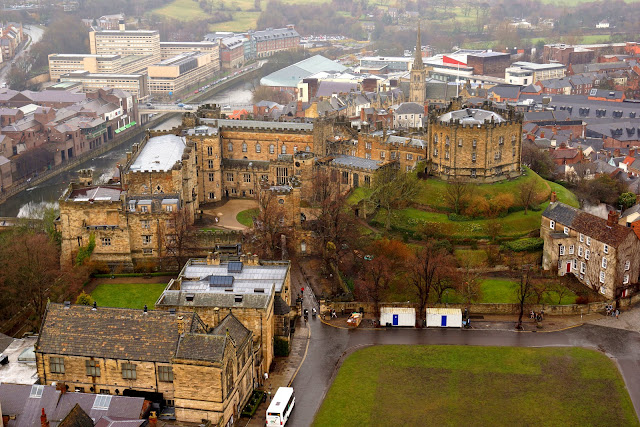
Durham, Wear, river, cathedral
Together with the cathedral, Durham Castle forms part of a UNESCO  World Heritage Site
As with most cathedrals there is, if you're willing to pay for it, the opportunity to climb to the summit of the tower via an increasingly precipitous spiral staircase. I love going up these. It's a mixture of ingenious engineering, function playing second fiddle to form, the mild peril involved when you have to pass another climber and the always spectacular views from the top that combine to give a special experience every time.

The cathedral is possibly the most complete Norman building in the country and the eastern portion of the interior has a very different feel about it from most other cathedrals in the country. The great antiquity of the structure comes at a significant cost; literally. It takes about £40,000 per week to keep the cathedral in a decent state of repair, mostly in the form of wages for the six stonemasons, three joiners, two maintenance technicians and four gardeners employed in its upkeep, as well as a resident archaeologist that records and oversees much of this work.

Durham, Wear, river, cathedral
The eastern façade
Once we had explored the cathedral it was time for lunch and we did well to find some excellent fish and chips, which always goes down well. By this time the sun had come out and our walk along the river back around the peninsula was a very different affair to our first encounter. The water was very still which gave me the chance to get some good reflections as can be seen in my first picture in this post.

So, I got to go to Durham; but this begs the question: how will I be enticed to make the trek north from now on? A visit to Whitby? Walking on the north Yorkshire Moors? Who knows, frankly.

Durham, Wear, river, cathedral
Looking up at Durham cathedral from the river Wear

Saturday, 14 July 2012

In Brugge


Brugge Bruges canal medieval river church cathedral belfry
One of the embarkation points for the canal tours that thread through the oldest part of the city
About a month ago we decided we wanted to go on an impromptu city break and after an intensive program of brainstorming, focus groups, consultations and feasibility studies (Sue: How about Brugge? Me: Yeah, okay) we decided upon Brugge. We thought it might be nice to have some travelling buddies on this one so we rounded up a posse and set off on a Friday after work.

The obvious way to get there is through the Chunnel, it only takes two hours to get to Brussels where we changed onto a local train and within another hour we were in one of Europe's most unblemished medieval cities. At the time I hadn't paid very much attention to the times of these trains, I just assumed it would take quite a long time, so I was impressed with the three hour travel time. We can't even get to (most) of our parent's houses in that time.

Brugge Bruges canal medieval river church cathedral belfry
In the background, the Church of Our Lady

Having had a week to think about it I still can't decide if it's the cobbled, winding streets that defines Brugge or its network of canals that thread their way through the city like a spiders web that has seen better days. On reflection it must be the interplay between the two that lend the city its charm and character. It certainly has both in spades. We arrived at the train station shortly before the medieval bells of the city began peeling the new day. My usual studies of maps of the city beforehand had revealed that it was less than two miles to our hotel and so we decided to walk and get a feel for our host of the next couple of days. The other main bit of preparation that we had all done for this trip was to watch In Bruges, the brilliant film by Martin McDonagh (you should also check out The Guard by his brother John, that would be an awesome double bill). This basically meant that we spent an unhealthy proportion of the weekend quoting and swearing our way through the streets. I highly recommend such a strategy.

Inevitably, there was an Irish pub 100 yards from our hotel but at least this meant that we had somewhere to have a drink into the small hours of Friday night and, in fairness, it was actually a decent place with good beers, good atmosphere and live music.

Brugge Bruges canal medieval river church cathedral belfry
An artist's impression of the famous belfry

Much like every other tourist our rough itinerary consisted of beer, canals, chocolate and cathedrals; not necessarily in that order. Quite literally every street in Brugge has a chocolate shop and many have up to a dozen; there must be scores of them in total. It is all delicious but it is also expensive, expect to pay easily over twenty quid if you want to have more than enough to simply last the train journey home. Eating and drinking in general is quite tough on the wallet, we just had to accept that we were going to pay €6-7 for a pint and €20 or so for a straightforward dinner; there aren't many places in the world where Londoners can go and feel like things are expensive but this was definitely one of them. The sting of this was slightly mitigated by the mirth caused by using the words Hoegaarden (a beer) and slaagroom (chantilly cream) as frequently as possible.

Perhaps the best way to see the town is by canal and by horse. A thirty minute boat trip with multilingual guide only costs a few Euros per person; a thirty minute horse trip is a bit more pricey, in the order of €38 but as there were 5 of us it wasn't too bad.

The tallest building in Brugge isn't the famous belfry but the spire of the Church of Our Lady. At 122 metres it completely dominates the skyline and is nearly half as tall again as the next highest building. Close up it looks relatively new; it's very clean and isn't particularly ornate but even its most recent sections are more than half a millennium old. It is also the second tallest brick tower in the world second only to St. Martin's church in Landshut, Germany. Disappointingly, it didn't appear possible to go up the tower during our visit.

Brugge Bruges canal medieval river church cathedral belfry
The Church of Our Lady

Also slightly disappointing was the view from the top of belfry. Having queued for a good hour we finally got to haul ourselves up the 366 increasingly narrow steps to the summit of the bell tower where I had hoped for wide panoramas of the town square and beyond. Unfortunately, all the openings at the top were covered up with chicken wire so that even getting a half decent single shot was all but impossible nevermind a sweeping vista of a shot. It is, nonetheless, an impressive stucture, built in three main phases between the 13th-15th centuries.

One of the highlights of Brugge is its myriad array of beers. There are over 150 breweries in Belgium brewing between 600-1000 beers depending on who you listen to, that means there is a huge amount of choice. We set ourselves the target of never drinking the same beer twice, a challenge that proved fairly easy to meet. As we essentially ordered beers at random it did mean that we occasionally got one that we weren't so keen on but on the whole it went down a treat. You can do a tour of De Halve Maan (The Half Moon) brewery that lasts about 45 minutes and throws in a free beer at the end. I really enjoyed the tour, it had a good mix of history and the science and processes of the beer making tradition. I never knew that so much nudity was integral to brewing a tasty pint.

Brugge Bruges canal medieval river church cathedral belfry
The 83 metre high belfry tower
It is Brugge's access to the sea that made it such a prosperous town. The port was a gateway to the markets of the world, they exported cloth and bought up spices. The money that flooded in led to the establishment of one of the first worldwide commercial powers. Banking, and the power and influence that come with it, rapidly made Brugge a force to be reckoned with in northern Europe. It was here that what could have been the first stock exchange in the world was established. All this prosperity grew Brugge to a size of more than 200,000 inhabitants, more than twice as many as it has today. In the 1650s the future Charles II made his court there in exile whilst Cromwell ruled over England. The erosion of this once mighty city though was literally that. The water channel that gave Brugge its sea access began silting up so that the deep water vessels of world trade were no longer able to get there. Within 200 years the population had shrunk by 75% and Brugge became a quiet backwater.

Today the port has been revived a little but tourists buying up the chocolates and beer is what keeps the town going. Ironically, it is the lack of recent prosperity that has now led to its revival. There is no heavy industry, no ugly glass and steel monoliths to modern living. Walking the streets is like stepping back in time. The swans on the canal, the market square, the cathedrals - it's like a fairytale.