Sunday, 28 October 2012

Land of Ice and Fire. And Rain.


geyser, Iceland, Reykjavik, eruption, steam,


The Land of Ice and Fire is how Iceland likes to brand itself, not entirely unreasonably either. It's home to many glaciers, including Europe's largest, and is the second most volcanic country in the world after Hawaii. But I would recommend, just for accuracy's sake you understand, the slight addendum of 'and rain'. In the days we were there it only stopped raining for 100 minutes; admittedly they were an amazing 100 minutes with some of the most crystal clear light and beautiful countryside I've ever seen but still. Now I know what you're thinking: the Welsh tourist board has already cornered that market, but I don't see why they couldn't come to some sort of mutual agreement.

When you live in a place where you're likely to spend a large portion of the year battling the elements it's always nice to know that at the end of the day you can have a nice hot bath and, thanks to another aspect of Iceland's extreme nature, Icelanders have a better deal than most. 14% of the surface of Iceland is covered by lakes, there are many underground reservoirs too and where these are found near to one of the many vents to the Earth's core that the country straddles the result is a vast aquifer of ready made bath water. You see, the mains water that gets pumped into Reykjavik isn't cold like ours but piping hot and so whereas we have to wait for the water to get hot they often have to wait for the water to get cold.

The reason Iceland is so geologically active is that it sits astride the mid-Atlantic ridge, in fact, worse than that, the fault line actually splits in two right in the middle of the country. This has resulted in there being more than 30 active volcanic systems in the country and one third of the total magma that has erupted to the Earth's surface in the last 500 years has been on this one island. In 1783 the Laki volcano erupted, and it was a real monster. The guy that told me about it said for me to look up the history of my country, or any country in the northern hemisphere, for that year and it would be mentioned; and he was right. That summer was known as the Sand Summer in the UK because the sky was changed to a pallid yellow from all the sulphur that was belched into the atmosphere. Ten thousand Britons were killed by the fallout from the eruption. One third of the population of Iceland were killed. Chilling statistics like that is probably why locals were all a bit nonplussed when their last major eruption was under way resulting in flights throughout northern Europe being grounded due to worries about the ash cloud. Apparently they found it genuinely amusing that people would get so worked up by such a small eruption and annoyed that the world seemed incapable of pronouncing a simple word like Eyjafjallajökull. 

geyser, sulphur, blow hole, spring, erupt, steam,
A close up of the blow hole, so to speak, between eruptions. It smelt as bad as it looks.

All the poor weather we encountered meant that there was no chance of seeing the Northern Lights, which was a shame but not a surprise as I knew before we left that solar activity was low. Luckily, though, we did get to see the other main thing that I wanted to get out of the trip, whales. Minke whales, to be precise. These baleen whales are normally solitary but we managed to find two together that were presumably feeding on a ball of herring or some other such fishy goodness. The rolling of the waves and the lash of the wind and rain meant that the only vaguely in focus shot I managed to get was less than impressive but, for me, this particular encounter wasn't about photography, it was about seeing one of nature's wonders up close and personal. So although I didn't get a heap of shots of humpbacks breaching and fluking I was still more than pleased with my day.

When I'm away I now increasingly approach any new place with a view to how I'm going to represent it on this blog. What story am I going to tell? What are the key elements I need to photograph? What caption would fit here? And if I come up with a good turn of phrase I'll quickly note it down knowing that my awful memory will inevitably let it fall from it's grasp. But on this occasion I was content to just stand there trying to guess where they would surface next whilst simultaneously trying to dodge the increasing quantity of vomit puddles on deck and not fall into the briny deep. And there was a lot to dodge too, let me tell you; I hadn't seen that many people vomiting with wild abandon in one place since my last night out in Cardiff. Sue does not cope well on boats and, whilst she wasn't a contributor to the fish food being mopped overboard that day, she felt pretty rough the whole time we were out there but she manfully fought it all the way and coped extremely well. As we chugged back into the harbour she said that I have my 'roller coaster' face on. For those that haven't gone on a trip to Alton Towers with me this basically means I have a fixed grin on my face combined with a sort of wildness in the eyes that gives me an altogether unhinged appearance. This means I've had fun. The only slightly unsettling thing about the trip was that in the opposite berth to our whale spotting ship were two whale hunting ships; a stark reminder that these impressive creatures have no protection in Icelandic waters. The argument goes that they have been doing this for a thousand years, it's a part of their culture, why should they have to stop now?

dorsal, fin, whale, Iceland, Reykjavik,
Minke whales are known for the small size of their dorsal fin compared to their body size

More of a struggle was our next excursion where the plan was to spend the day going to Thingvellir, the seat of Iceland's ancient parliament the Althingi; a set of geysers, one of which is called geyser and is what every other geyser in the world is named after; and also the Gullfoss waterfall. The weather was absolutely appalling, incessantly, all day and it was particularly annoying for this last item on the agenda as it is one of the most impressive waterfalls I've ever had the good fortune to visit. I could have easily spent a whole day just photographing this one location but all that I could do was snatch a few hastily composed shots before my camera got saturated. The photo I've included here has rain drops on the lens and the sky looks miserable; it's a damned fine waterfall, though. I could probably say the same thing about the geyser; to really appreciate it you would need a nice blue sky to give some contrast to the vast, boiling jet of water that surges upwards every 4-8 minutes. As it was, in my photos, it just sort of blends into the background so that you can't really get a feel for the dynamism of the moment.

Before we set off on this trip there were several 'facts' about Iceland that I wanted to check out, like: Iceland has no trees; Iceland has no dogs; in any town there is only one shop where you can buy alcohol and it's run by the Government, and a few others. It turns out that only the last of these is true. Iceland does have trees but the rule of thumb is that if it is taller than a man then it is an imported species. The saying goes that if you ever get lost in an Icelandic forest then just stand up. And Iceland definitely has dogs, in fact it even has native dogs. When the first human settlers arrived the Arctic fox was the only mammal living on the island. That has now changed with the introduction of sheep, reindeer, rabbits and the inevitable rats and mice. A generation ago a farmer asked permission of the Government to import some mink so that he could farm them for their fur. The Government said no on the grounds that they might escape and overrun the country. The farmer continued to apply for years but the answer was always the same. Eventually the farmer died but then his son took up the cause and continued to apply. He commissioned specially built mink-proof cages from which there could be no escape and, eventually, the authorities relented and granted him a license. Within four days the mink had escaped and so they complete the list of mammals you can find in Iceland.

gullfoss, waterfall, Iceland, water, Reykjavik, stone, sky
The lower section of the Gullfoss falls

I really enjoyed our time in Iceland. At times the weather had completely kicked our arse but it was always beautiful and always compelling. If it wasn't so damned expensive it would definitely be a regular haunt as it only takes three hours to get to and has lots to offer anyone that likes wild landscapes and a strong Arctic wind. At some point we were looking through our guidebook and it mentioned that Reykjavik is the northern-most capital in the world; I love this sort of thing. I like having things that I can tick off of a list, especially things of a geographical nature such as this. It can go on the list right under the other places I've gone like southern-most town, northern-most town, highest altitude town. As we were discussing this, and as we rapidly approach our tenth anniversary of travelling the world together, we decided to tot up all the different countries we had visited as a pair, ignoring ones we had gone to the one without the other. We were somewhat startled to come to a total of 25 countries, an eighth of the world's total. That's good going; but then we realised that at that pace it'd take 80 years to get them all done - the Ultimate List. Must up the pace.


Sunday, 14 October 2012

Reykjavik


Reykjavik, harbour, Iceland, sky, sea, mountain, cloud, sculpture, reflection, mount Esja, Faxafloi
The reflection underneath is a bit spidery for my liking.....
Takk. That's how you say thanks in Icelandic; nice and easy. Every other word in the language, every single other word, is completely unpronounceable. You might be forgiven for thinking that there would be some slight similarities between Icelandic and English, they both have a solid Norwegian base to them from when  our two islands were colonised by the vikings in the last half of the first millennium; but you would be wrong. Very wrong. Icelandic is actually more like ancient Norse than modern day Norse is; due to centuries of isolation and a policy of actively coming up with words with an Icelandic root instead of borrowing from other languages it has evolved very little. As examples of the way they police their language: their word for computer translates as number prophetess; telephone is long thread; mobile phone is travelling long thread; and, rather worryingly, they have no word for interesting. To hear Icelandic spoken is, however, quite interesting. It has a fairly quiet and reserved tone to it, as do the people in general, but every now and then, out of no where, they throw in an exaggerated ook sort of a noise as if they're trying to out honk one of the local geese that populate the area in place of the pigeons you normally find in most cities. Imagine a drunk Welshman doing a Monty Python impression and you might be half way there.

Names, of people, are also a little unusual. Similarly to Russian they have a patronymic and matronymic system; basically you come up with a forename for your new son but his surname is already decided - it's his mother's name with son added onto it. Concordantly, the surname for a girl is her father's name followed by the Icelandic for daughter, dottir. To clarify, I would be called Jason Pearlsson, my wife would be called Susan Davidsdottir and SKY news correspondent Kay Burley would be Kay Satansdottir. Simple.

So it was that Sue Davidsdottir and I set off into this alien culture with aspirations of whale watching and a good view of the aurora borealis; sadly, we would only achieve one of these.

Reykjavik, harbour, Iceland, sky, sea, mountain, cloud, sculpture, reflection, mount Esja, Faxafloi

Reykjavik was first settled by Norse colonists in the year 870 and was called such because you can just about make out steam from nearby hot springs (Reykjavik means Smokey Harbour); the city, indeed the country, was mostly just a fishing and sheep farming outpost for the next several centuries and when the city received its charter from their Danish rulers in 1752 the population had grown to a colossal 167 individuals. The charter wasn't granted to the people themselves or some sort of mayor or ruler but to a corporation that was tasked with developing native industries with a view to improving living conditions of the indigenous population. Today there are 120,000 people in the city and 320,000 in the country as a whole and they are free to enjoy what is widely acknowledged to be amongst the best healthcare and educational systems in the world. This is probably in no small part due to the fact that 80% of the tax collected in Iceland is spent on those two areas alone. This, combined with the fact that they have no standing army, 100% of their power comes from geothermal or hydroelectric sources and a few other key indicators, has led to Iceland being rated the most peaceful country on Earth.

Reykjavik, Iceland, Tjomin, lake, sky, town houses,
The most built up area in all Iceland; some of those buildings are as many as four storeys high!
Despite being the largest city in Iceland by quite some distance Reykjavik has maintained the feel of a sleepy fishing town. The picture above is from the top of the Hallgrimskirkja cathedral looking west towards the harbour over the most developed part of the city but it looks more like a leafy suburb. As they have chosen not to build upwards it does mean that the urban sprawl continues for some miles east and south and is beginning to swallow up what used to be smaller satellite towns in the same way that Copenhagen and Oslo have done.

The panorama below is of the far side of lake Tjomin which nuzzles up against the side of the Icelandic parliament thAlþingi, pronounced AL-thing, the oldest parliament in the world at well over 1,000 years old. I like the contrast in the leaves of the trees as they begin their journey from green to brown through yellow and red. It also nicely highlights the degree of variation that is to be found in Icelandic architecture; it's quite unusual to find two buildings next to each other that are the same and this makes walking the streets of the capital all the more interesting. This is in stark contrast to the unrelenting tedium of new, suburban developments in the UK where conformity seems to be the order of the day.

Reykjavik, Iceland, sky, lake, cloud, panorama, trees, autumn


I really liked Iceland. As soon as I stepped off of the plane and saw the bleak, rugged landscape and felt the icy wind bite I knew that I was going to enjoy this rough, harsh country. When I go on holiday I prefer to see mountains and ice over sun and sand; I like to feel that at any moment the weather could turn and you'll be hit with a storm that makes even getting something to eat an ordeal. This is just as well, because this is what we got. Our first day was wet, cold and blustery; pretty bad weather-wise. From bad it turned to brutal as winds reached gale force and the rain got heavier and heavier so whilst I enjoyed doing battle with Iceland and its weather it did mean that photography opportunities were few and far between, not if I wanted my camera to avoid a soaking in any case.

In my next post I'll describe the trials and tribulations of sightseeing in a country that is the second most volcanic in the world and sat between two of the roughest oceans we have. For now I'll say that there was a brief moment of respite; for two hours on our final morning in Reykjavik the rain stopped, the wind dropped  and the clouds parted. For two hours the sun shone through and gave me some of the most beautiful, crystal clear light I have ever seen. When I saw how things had improved I instigated a desperate rush around the city revisiting the key landmarks that we had been perusing under much less favourable conditions for the last few days. Even though it was almost noon the sun was still very low in the sky as we were only a degree or so from the Arctic circle. For the shots of Mount Esja and the Sun Voyager sculpture the light also happened to be coming in from the side and so was perfect for giving depth to the mountains. I am very happy with the panorama below, it is well worth looking at on a big screen and I foresee a canvas print of it on my living room wall in the not too distant future.


Reykjavik, harbour, Iceland, sky, sea, mountain, cloud, panorama, Faxafloi, Mount Esja
Click to enpanaramatudinate


Friday, 28 September 2012

Starry, Starry Night


star, star trail, long exposure, astrophotography, Milky Way

First of all, a spoiler. The last photo in this post is a very special one. It's not one of mine and in of itself it is unremarkable but its importance can't be understated. More later.

*          *          *

At bloody last. For over one and a half years I had been waiting and I was finally going to get a chance. For 18 months I had been waiting to be in a rural location with a clear, cloud-free night. My goal was to take pictures of the stars and so I needed to be somewhere rural so as to avoid light pollution and I needed it to be cloudless for, well, obvious reasons. 

I am passionate about stars and the cosmos they sit in. I read more about physics, and astronomy in particular, than any other topic; more than the biology of my day job and the photography of my spare time. Asides from their preternatural beauty I love that they give up so many of their secrets simply by our study of the electro-magnetic radiation they give off; of which the visible light we can see is but one segment.

Within about 17 minutes of the Big Bang nearly all of the matter and anti-matter initially created in the universe had annihilated each other and left only hydrogen (75%) and helium (25%); all the other elements of the periodic table, which today make up about 2% of the matter in the universe, was created in the extreme conditions found inside stars where the intense temperature and pressure literally fuses protons together. What this means is that every single thing you can see is made of atoms that were created in the inferno of a star - we are all made of star dust.


In my first two photos here I have tried to capture the Milky Way, running top to bottom through the centre of the picture, with mixed success. The first one probably shows it most clearly but the exposure was a bit on the long side (188 seconds) so the stars are starting to move; they're in an awkward stage where they're not in sharp focus but they're not drawn out enough to be a proper star trail so it just looks a bit blurry, which isn't great. But I do like the garden being in the bottom of the frame as it gives the shot some context and sense of scale. What did surprise me was the orange glow in the lower portion of the sky, there was no hint of that with the naked eye. It looks as if I'm still in London and there is a city's worth of light pollution just around the corner but the nearest street light was about half a mile away in a small village, the nearest town was over 4 miles away; and yet there is still so much light pollution.

I tried to address the glow with the second picture by not including the horizon and pointing the camera straight up into the sky which seemed to do the trick although the exposure, again, is a little too long at 147 seconds.

The picture I was most pleased with was this next one, which was the first I took. I ended up taking five photos in all over the course of an hour starting at about 3am. Given this was my first attempt and, if I'm honest, I was quite drunk, I think it's not too bad. This was a long exposure of just over 9 minutes and so that nasty orange glow is back but this time the stars have moved enough for it to give a proper star trail effect. Next time I'm going to see if a soft ND grad filter will help with the orange cast at all. I deliberately aimed at Polaris to get a pin wheel effect; Polaris remains motionless in the centre and all the other stars have an increased degree of movement as they radiate out. What I really like about this photo is how the long streaks allow you to see the actual colour of the stars for what they are; very few are white, most of them are blue or a yellow/orange colour which you just can't make out with the naked eye. If you're reading this on your phone then you might struggle to make out the detail, I recommend having a proper look at home on your laptop (does anyone still have a desk top these days), click on the picture to engalactify it.

Overall I was quite pleased with how the session went, I learnt a lot. Hopefully I won't have to wait so long for my next chance to refine my technique. Next month we are going to Iceland and if there are clear skies then there will be a decent chance of seeing the aurora borealis so no prizes for guessing what I'll be blogging about in October.

star, star trail, long exposure, astrophotography, Milky Way

I'm going to end this post with that special photo I promised you. It is a photo taken by a machine and inspired by one of my personal heroes. The machine was the Voyager 1 spacecraft, the person was Carl Sagan. In 1990 the primary mission was over and he finally persuaded NASA that this was an important image to try and get. NASA were reluctant as they would effectively have to point the camera at the sun and they were afraid it would fry it and, also, there was no scientific merit in the endeavour. Sagan knew better, though. You can see the Earth halfway down the brown streak on the right hand side. It is a pale blue dot (as this photo is now known) only  0.12 pixels in size; the streak itself is lens flare from the sun. This photo of our planet was taken by a man made object from 6 billion km away. Think about that; it's amazing. We did that. I'll let Dr. Sagan close up.....


'From this distant vantage point, the Earth might not seem of any particular interest. But for us, it's different. Consider again that dot. That's here. That's home. That's us. On it everyone you love, everyone you know, everyone you ever heard of, every human being who ever was, lived out their lives. The aggregate of our joy and suffering, thousands of confident religions, ideologies, and economic doctrines, every hunter and forager, every hero and coward, every creator and destroyer of civilization, every king and peasant, every young couple in love, every mother and father, hopeful child, inventor and explorer, every teacher of morals, every corrupt politician, every "superstar," every "supreme leader," every saint and sinner in the history of our species lived there – on a mote of dust suspended in a sunbeam.'

Dr. Carl Sagan

Sunday, 9 September 2012

Pelicans

Namibia, Swakopmund, pelicans, cape seals
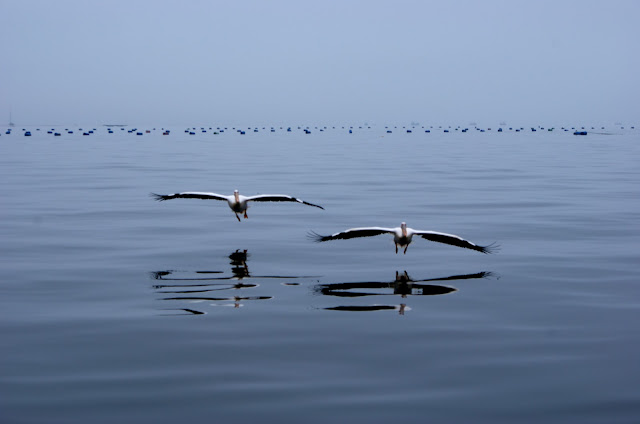
The blue buoys in the background are markers for an oyster farm

Here is a set of images I took nearly three years ago now of a pair of pelicans coming in to land. My wife and I were in a small boat off the coast of Swakopmund, Namibia and the pelicans knew that if they came and said hello they would be rewarded with a few choice mackerel. Taken together the three images give a great sense of the grace and control these birds have as they come in to land, but, we almost missed the opportunity all together....

Namibia, Swakopmund, pelicans, cape seals

The town of Swakopmund, (one of my favourite place names of all time, right up there with Saqsayhuaman and Fingringhoe) can be found about half way up Namibia's long Atlantic coast line almost directly west of the capital Windhoek. It's a curious little town, a bit like, I imagine, stepping back into 1970s East Germany. Not in a Stasi, Eastern Bloc kind of way but in a way that brought to mind what Germany might have been like without the burden of mass industry and high technology. You see, during the Scramble for Africa we got South Africa, Egypt, the Sudan and others; Belgium got what is now the DRC; the French got much of the north west of the continent and Germany got a portion down in the south west of Africa which they called, with typical Teutonic imagination, German South West Africa, now known as Namibia. The result of this was a little slice of Bavaria in the desert on the opposite side of the world.

Streets in Swakopmund have names like Nord Ring, Heuschneider and Mittel Straße and it couldn't be easier to find a cold, European style beer and a stein to drink it out of. Nationally, one third of white Namibians speak German and this proportion is thought to be higher still in Swakopmund. So, pretty German, then. It was for this reason that we were rather worried that we were going to miss our boat trip as Germans don't tend to be keen on tardyness. You see, we were under the impression that we were going to be picked up from our awesome accommodation and taken the 20 miles or so down to Walvis Bay where the trip began; but more than 20 minutes after we expected to be picked up we found out that we were going to have to make our own way there and average a mile per minute in the process. We were on a driving holiday, doing a lap of Namibia and so we had our own wheels but this was still less than ideal. We covered thousands of kilometres on that holiday and more than 90% of it was on gravel roads; luckily this little stretch was 100% lovely black top.

Namibia, Swakopmund, pelicans, cape seals

With Sue doing her best Jensen Button impression we made it. Just. But it cost us some light ribbing from the boat load of middle aged German tourists that seemed to punctuate our way around the country, Namibia being quite a popular tourist destination for our Germanic cousins. The main point of the trip was to see the enormous Cape Cross seal colony and, if we were lucky, dolphins; we knew the pelicans would be there but we didn't give them much thought. As we saw them come gliding into view though, through the early morning mist over a perfectly still Atlantic, they had an undeniable majesty to them that let me easily capture a great little series of images.

Another highlight was when a, presumably semi-tame and well rehearsed, male seal climbed up the back of the boat and onto the deck. Now, we were not on a large boat, she was only about 20 feet from bow to stern so to have a 9 foot seal weighing a third of a ton lumbering about was, I admit, a little disquieting. All of a suddenall the human cargo had to pin themselves to the side railings to give this behemoth room to, well, generally stink the place up. If I'm honest, my lasting impression of this encounter nearly three years on, once you've got used to the enormous size and very pointy looking teeth, is that seals really, really stink of fish. I guess he was quite cute in his own way, and he certainly seemed to appreciate his free breakfast.

The last picture I'm going to show you from this trip was one I caught on the fly, so to speak. It still cracks me up every time I see it. I would say that this shows pelicans looking slightly less graceful than in the previous photos and if you look carefully you can just about see a fish below it's beak that had been thrown for it to catch.


Monday, 27 August 2012

South Bank Sunset

London, Thames, bunting, sunset, river, lamp post, silhouette
Thames-side bunting, perhaps left over from the Jubilee celebrations


Those of you who follow me on Twitter will know that last Sunday I went on a London Photo Walk along the South Bank. This is basically a group of people that meet up and then stroll along a pre-agreed route taking pictures as we go. This is only the second walk that I've been free to go on, the first one being on Broadway Market back in January which I wrote about here and here. It's a really informal meet and the idea behind it is simply to meet up with a group of friendly, like minded people. I normally take my best photos when I'm on my own, when I have the time to focus on what I'm doing, take my time and not feel guilty about slowing down or ignoring whoever I'm out with, normally my wife. It's a little bit different with this group though as we all have the same ultimate goal: to share ideas and put them into practice.

London, Thames, bunting, sunset, river, lamp post, silhouette
This busker made a good silhouette but was singing Coldplay so I had to be quick
When the route for this particular walk was decided I had mixed feelings; I love the South Bank, I go down there at least every fortnight if not more often, the walk along the Thames from Westminster to Tower Bridge is one of my favourite past times; but, on the other hand, there is probably no where on Earth that I have more thoroughly photographed so would there be anything there to catch my interest?

The simple answer is: yes, of course. If I went there every week for the rest of my life there would still be new and interesting pictures to be taken, and if one day I went there and couldn't see anything exciting then it would be my lack of imagination that was at fault.

So what was there to see? Well, we stated at the London Eye and walked passed the South Bank Centre and on towards the Tate Modern; there, we crossed over the Millennium Bridge, scooted around the east side of St. Paul's and headed for the roof of One New Change, a new shopping centre. On the roof they have a bar and restaurant and also a terrace that offers views south and west back towards our start point at Jubilee Gardens and County Hall. The main feature of this fantastic view, though, was the up close, up high vista of the dome of St. Paul's cathedral. I highly recommend a quick trip to this terrace if you are in the area, it really is a great view and is separate from the bar so you don't need to pay to be up there.

London, Thames, night, St. Paul's, cathedral
Sir Christopher Wren's masterpiece, St Paul's Cathedral
As you can see, it had gotten dark by the time I took this one but that was always the plan; the theme of the walk was sunset, which is why many of my photos make use of silhouettes. The photo I am most proud of however is the one below. Many times as I have walked beside the Thames I have tried to take a photo that does justice to the lamp posts that line the route. They are incredibly ornate and deserve a suitably dramatic portrait. The problem is that if you do close ups you just notice that they're really quite dirty and if you do a wider angle shot then they just get lost in the busyness of the cityscape. Here, though, I think I finally nailed it.  The shot is close enough to reveal some of the detailing of the lamp posts and yet wide enough to give them context. The silhouette effect helps remove detail from the mid and foreground so that they remain the central focus and I also like the perspective as they slowly recede deeper into the picture.

London, Thames, sunset, river, lamp post, silhouette
My favourite picture of the day
Any Londoners reading this that want to find out more about the group can do so here and I'll end by saying thank you to the organisers for another successful walk.